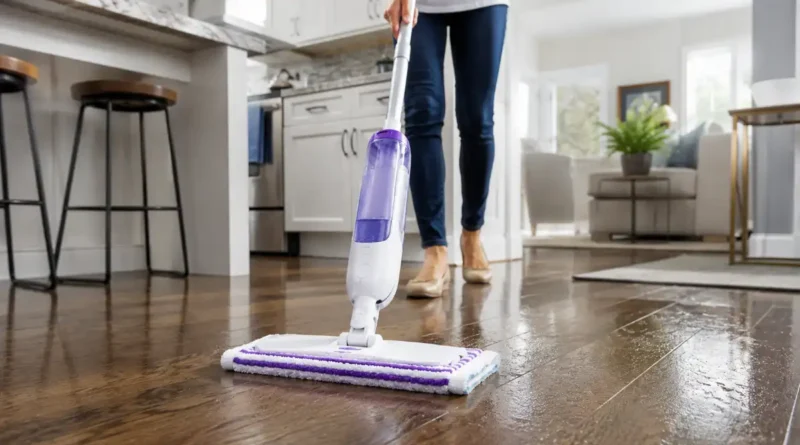
Swiffer PowerMop: Complete Guide to Features, Setup, and Real Performance
Mopping with a bucket takes time, especially when you have to rinse a dirty mop head and change the water. The Swiffer PowerMop takes a different approach: it sprays pre-mixed cleaning solution onto the floor and uses a thick disposable pad with scrubbing strips to clean the mess.
Swiffer says the PowerMop delivers a mop-and-bucket clean in half the time, while its pads provide 5X the cleaning power of Swiffer WetJet pads based on pad layers. Independent testing suggests it is particularly effective for sticky spills and routine cleaning, but it still has limitations with loose debris, heavy spills, disposable-pad costs, and rough or uneven flooring.
So, is the PowerMop actually worth buying? For quick cleaning of sealed hard floors, it can be. But it is not a complete replacement for every type of mop.
What Is the Swiffer PowerMop?
The Swiffer PowerMop is an all-in-one spray mop from Procter & Gamble. It combines a solution reservoir, spray system, swiveling mop head, and disposable cleaning pads into one system.
The PowerMop uses pads with hundreds of raised scrubbing strips designed to reach into grooves and help remove sticky messes. Swiffer currently describes the standard PowerMop as suitable for finished surfaces including finished wood, luxury vinyl, tile, and laminate.
The PowerMop is available in two main versions:
- PowerMop Multi-Surface: Designed for a range of finished hard floors, with standard scrubbing strips and pre-mixed cleaning solutions.
- PowerMop Wood: Designed specifically for finished wood floors, with gentler cleaning strips, a QuickDry formula, and LED lights that help illuminate dirt and debris.
Swiffer says the Wood version’s QuickDry formula dries up to twice as fast as Mr. Clean All Purpose Cleaner.
Neither version should be used on unfinished, oiled, or waxed wood, non-sealed tile, or carpet because those surfaces may be sensitive to moisture.
Swiffer PowerMop Features at a Glance
| Feature | Swiffer PowerMop |
| Mop type | Battery-powered spray mop |
| Mop head | 360-degree swivel |
| Pad design | Disposable pads with hundreds of scrubbing strips |
| Standard pad width | 15.25 inches according to independent testing |
| Spray system | Fine-mist spray with two nozzles |
| Cleaning solution | Pre-mixed PowerMop solution |
| Starter kit | Mop, solution, 2 batteries, and 2 pads |
| Wood version | Gentler strips, QuickDry formula, LED dirt-illuminating lights |
| Suitable floors | Finished wood, luxury vinyl, tile, laminate and other compatible finished surfaces |
| Avoid | Unfinished/oiled/waxed wood, non-sealed tile, carpet |
- Read more: Swiffer PowerMop
The starter-kit contents are confirmed by Swiffer’s current product listing.
How to Assemble the Swiffer PowerMop
Assembly is straightforward and does not require tools.
- Connect the three handle sections, aligning the notches until they click together.
- Attach the lower handle section containing the mop head and solution compartment.
- Open the battery compartment and install the included AA batteries.
- Push the PowerMop solution bottle into its holder until it clicks into position.
- Attach a fresh mop pad with the scrubbing strips facing the floor.
Independent testing confirms this basic setup process, while Swiffer’s own instructions simplify the cleaning process to attaching the pad, inserting the solution, spraying and mopping, and discarding the dirty pad.
How to Use the PowerMop
Once assembled, the PowerMop is designed to be simple:
- Attach a clean pad.
- Insert the PowerMop cleaning solution.
- Press the spray button to apply solution to the floor.
- Push and pull the mop over the dampened area.
- Remove and discard the used pad when you’re finished.
There is no bucket to fill and no mop head to rinse or wring. Swiffer specifically markets the system around this reduced setup and cleanup process.
For best results, remove loose dirt, crumbs, hair, and other debris before mopping. Independent testing found that the PowerMop’s pads are much better at handling liquid messes and residue than larger pieces of loose debris.
Is the Swiffer PowerMop Good for Everyday Cleaning?
Yes, if your floors are sealed and your messes are mostly routine spills, dirt, and sticky residue.
The PowerMop’s biggest advantage is convenience. You can grab it, spray the solution, clean the floor, and throw away the pad without dealing with a bucket.
Independent testing found the PowerMop particularly effective on sticky messes such as syrup, milk, and pet-related accidents. Its 15.25-inch pad also covers more floor per pass than the WetJet’s narrower pad.
However, it is not the best tool for every situation. Large spills, heavily soiled floors, or floors covered with loose dirt may still be better handled with a traditional or reusable mop.
Real-World Performance: What Works
Thick scrubbing pads
PowerMop pads have more than 300 scrubbing strips, according to Swiffer and independent testing. These strips are designed to work into grooves and help remove sticky spills and grime.
This is one of the biggest differences between the PowerMop and WetJet.
Wide cleaning path
Independent testing measured the PowerMop pad at 15.25 inches wide, compared with approximately 11.5 inches for the WetJet pad. The wider pad can reduce the number of passes needed to cover a floor.
360-degree maneuverability
The mop head swivels 360 degrees, making it easier to turn around furniture legs and navigate tight areas. The head can also lock into position, which can help when cleaning vertical surfaces such as baseboards.
Low-profile design
Because the solution container is positioned toward the front of the mop, independent testing found that the PowerMop can lie nearly flat and reach under furniture with roughly an inch of clearance.
Fine-mist spraying
The PowerMop uses two spray nozzles. Independent testing measured its spray reaching about 22 inches from the mop head, although the spray remained relatively narrow compared with some competing spray mops.
What Doesn’t Work as Well
It doesn’t replace sweeping or vacuuming
The PowerMop is primarily a wet-cleaning tool. Independent testing found that its pads don’t pick up larger pieces of debris particularly well.
If the floor has lots of hair, crumbs, sand, or loose dirt, sweep or vacuum first.
Pads can be expensive over time
The convenience comes with a recurring cost. PowerMop pads are disposable, and Swiffer recommends replacing them rather than washing and reusing them.
For occasional cleaning, this may not matter much. If you mop frequently, however, replacement pads and cleaning solution can cost considerably more over time than a reusable microfiber mop.
Pad attachment can be an issue on rough floors
Independent testing reported that the pads sometimes detached when used over cracks, grout lines, floorboard gaps, or rough textures.
This does not mean every PowerMop will have the problem, but it is worth considering if your flooring is particularly uneven.
Fragrance may be noticeable
PowerMop solutions are scented. Current Swiffer listings include Fresh and Lavender options, as well as an Unstopables Fresh Scent formula.
Independent testing described the fragrance as strong and potentially overpowering in smaller spaces. That is a tester’s experience rather than a universal reaction, but it is worth considering if you prefer fragrance-free cleaning products.
It relies on batteries
The spray function uses batteries. The starter kit includes the required batteries, but the mop does not provide a conventional rechargeable battery system.
Independent testing also noted the lack of a battery-level indicator, meaning the batteries can run out without much warning.
Swiffer PowerMop vs. WetJet
The PowerMop is positioned as the more capable option, while the WetJet is the simpler and generally less expensive system.
| Feature | PowerMop | WetJet |
| Pad design | Thick pads with 300+ scrubbing strips | Flatter disposable pads |
| Pad width | About 15.25 inches | About 11.5 inches |
| Spray | Two-nozzle system | Spray system |
| Mop-head movement | 360-degree swivel | More limited movement |
| Locking head | Yes | No |
| Under-furniture reach | Very low profile | More limited |
| Cleaning focus | Sticky messes and deeper routine cleaning | Light everyday cleaning |
| Replacement pads | Generally more expensive | Generally less expensive |
| Solution | Pre-mixed PowerMop solution | WetJet-compatible solutions |
Independent testing found the PowerMop pad wider and more absorbent than the WetJet pad, while the PowerMop’s 360-degree swivel and low-profile design give it additional maneuverability.
One important clarification: Swiffer’s 5X cleaning power claim should not be interpreted as saying the PowerMop removes every type of dirt five times better than WetJet. Swiffer’s current claim is based on pad layers compared with WetJet pads.
Which one should you choose?
Choose the PowerMop if you regularly deal with sticky spills, want a wider cleaning path, or want the additional maneuverability of a 360-degree head.
Choose the WetJet if you mainly need a simple spray mop for light everyday cleaning and want to keep refill costs lower.
How Much Does the PowerMop Cost to Use?
The purchase price is only part of the equation.
The PowerMop system requires:
- Disposable replacement pads
- Pre-mixed cleaning solution
- Batteries for the spray function
The current standard starter kit includes the mop, one bottle of cleaning solution, two batteries, and two mopping pads.
Because prices change by retailer and promotion, it is better to check the current price before buying rather than relying on a fixed “average” price in an evergreen article.
The more important long-term question is how frequently you mop. Someone using the PowerMop for occasional kitchen spills will have a very different refill cost from someone using it throughout a large home several times a week.
PowerMop vs. a Traditional Mop and Bucket
The PowerMop wins on convenience.
You don’t need to:
- Fill a bucket
- Carry dirty water around
- Rinse the mop head
- Wring out the mop
- Clean the mop head afterward
A traditional mop wins on:
- Reusability
- Large spills
- Heavy soil
- Loose debris
- Long-term operating cost
That makes the PowerMop less of a universal replacement for a mop and bucket and more of a convenient alternative for routine maintenance cleaning.
PowerMop vs. PowerMop Wood
The two versions are designed for different flooring priorities.
Standard PowerMop is intended for multiple finished surfaces and uses standard scrubbing strips with pre-mixed PowerMop cleaning solutions.
PowerMop Wood is specifically designed for finished wood floors. It uses gentler strips, a QuickDry cleaning formula, and LED lights to make dirt and debris easier to see. Swiffer says its QuickDry formula dries up to twice as fast as Mr. Clean All Purpose Cleaner.
If most of your home has finished wood floors, the Wood version makes more sense. For mixed flooring such as tile, laminate, luxury vinyl, and finished wood, the standard PowerMop is the more versatile choice.
Who Should Buy the Swiffer PowerMop?
The PowerMop makes the most sense if you:
- Want quick cleanup without a bucket
- Have sealed hard floors
- Deal with frequent spills or sticky residue
- Prefer disposable cleaning pads
- Want a lightweight mop that’s easy to maneuver
- Need to clean underneath low furniture
It is less attractive if you:
- Want washable, reusable pads
- Regularly clean heavily soiled floors
- Have lots of loose debris that needs to be collected while mopping
- Have rough or deeply uneven flooring
- Dislike scented cleaning products
- Want the lowest possible long-term cleaning cost
Frequently Asked Questions
Can I use the Swiffer PowerMop on unfinished wood floors?
No. Swiffer says not to use PowerMop on unfinished, oiled, or waxed wood, non-sealed tile, or carpet because those surfaces may be water sensitive.
Do I need to sweep before using the PowerMop?
Yes, if your floor has loose dirt, hair, crumbs, sand, or similar debris. Independent testing found that the PowerMop is better at cleaning liquid messes and residue than picking up larger pieces of dry debris.
Does the PowerMop use reusable pads?
No. The PowerMop uses disposable pads designed to be removed and discarded after cleaning. Swiffer sells dedicated PowerMop replacement pads.
Does the PowerMop require batteries?
Yes. The spray function uses batteries, and the starter kit includes batteries. Independent testing found that there is no battery-level indicator.
Is the PowerMop better than the WetJet?
For deeper routine cleaning and sticky messes, the PowerMop is the stronger option based on its thicker pads, wider cleaning path, and 360-degree swivel head. The WetJet can make more sense if you mainly want basic everyday cleaning and lower refill costs.
Can I use PowerMop Wood on regular floors?
PowerMop Wood is specifically designed for finished wood floors. The standard PowerMop is the better choice when you need a system intended for multiple finished surfaces.