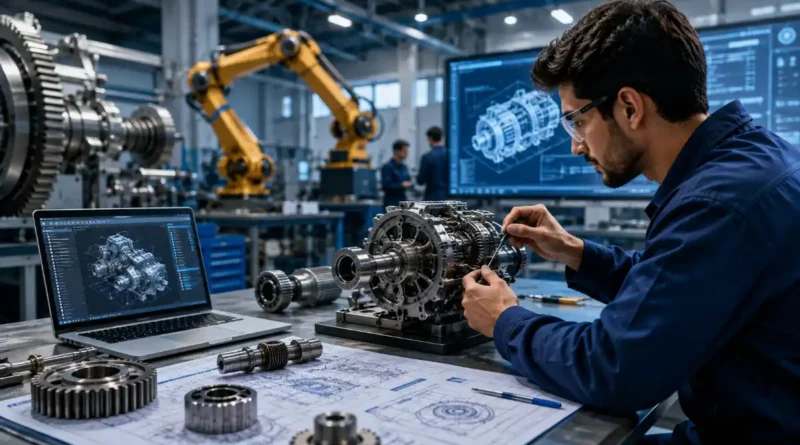
Mechanical Engineering: What It Is, Skills Required, and Career Salary Guide
Mechanical engineering is one of the broadest engineering disciplines. It applies physics, mathematics, materials science, and engineering principles to design, analyze, manufacture, and test machines, components, and mechanical systems.
Mechanical engineers work on products and systems involving motion, force, energy, fluids, heat, and materials. Their work can range from designing automotive components and industrial machinery to developing robots, HVAC systems, turbines, medical devices, and aerospace equipment.
If you’re considering mechanical engineering as a career, the short version is this: it offers broad career options, strong earning potential, and opportunities across many industries, but succeeding in the field requires more than an engineering degree. CAD skills, engineering analysis, manufacturing knowledge, problem-solving, and practical experience can make a significant difference.
What Do Mechanical Engineers Actually Do?
A mechanical engineer typically takes a product, component, or system from an initial concept through design, analysis, testing, and production.
Typical responsibilities include:
- Designing mechanical components and assemblies using Computer-Aided Design (CAD) software
- Calculating forces, stresses, temperatures, and other engineering parameters
- Running simulations to predict how components will perform
- Building or evaluating prototypes
- Testing products and identifying design problems
- Selecting appropriate materials and manufacturing methods
- Working with manufacturing teams to improve production processes
- Troubleshooting equipment and mechanical failures
- Preparing technical drawings, specifications, and engineering documentation
- Working with electrical, software, manufacturing, and other engineering teams
The exact job depends heavily on the industry and specialization. A design engineer may spend much of the day working in CAD, while an R&D engineer may focus more heavily on testing and experimentation. A manufacturing engineer may spend more time on production processes and factory problems.
What Subjects Does Mechanical Engineering Cover?
Mechanical engineering combines several technical disciplines.
Statics and Dynamics
Statics examines forces acting on objects that are not accelerating, while dynamics focuses on objects in motion. These concepts are fundamental to machine, structural, and mechanism design.
Thermodynamics
Thermodynamics deals with heat, energy, work, and energy conversion. It is important in areas such as engines, power generation, refrigeration, and heating and cooling systems.
Fluid Mechanics
Fluid mechanics examines the behavior of liquids and gases. Mechanical engineers use it when designing pumps, turbines, piping systems, fans, compressors, and aerodynamic components.
Materials Science
Engineers need to understand how metals, polymers, ceramics, and composites behave under different conditions. Material selection affects strength, weight, durability, cost, and manufacturability.
Heat Transfer
Heat-transfer principles are used to understand how thermal energy moves through conduction, convection, and radiation. This is important in engines, electronics cooling, HVAC systems, and industrial equipment.
Computer-Aided Design
CAD software allows engineers to create detailed 2D drawings and 3D models of components and assemblies. Common engineering workflows can also involve simulation, product lifecycle management, and manufacturing software.
- Read more: Mechanical Engineering
Education and Skills Required for Mechanical Engineering
Most mechanical engineering positions require a bachelor’s degree in mechanical engineering or a related engineering discipline. The U.S. Bureau of Labor Statistics (BLS) lists a bachelor’s degree as the typical entry-level education for mechanical engineers.
However, the degree alone does not guarantee strong career opportunities.
Technical Skills
Useful technical skills include:
- CAD and 3D modeling
- Engineering drawing and GD&T
- Mechanical design
- Finite Element Analysis (FEA)
- Computational Fluid Dynamics (CFD)
- Thermodynamics
- Fluid mechanics
- Materials selection
- Manufacturing processes
- Product testing
- Engineering calculations
- Basic programming and automation
The exact software and skills employers expect vary by industry.
Soft Skills
Mechanical engineers also need to communicate effectively with people outside their immediate specialty.
Important skills include:
- Problem-solving
- Technical communication
- Teamwork
- Project management
- Attention to detail
- Critical thinking
- Documentation
- Ability to explain technical information clearly
For students, internships, design projects, laboratory work, and practical engineering experience can help bridge the gap between classroom theory and workplace requirements.
Do Mechanical Engineers Need a License?
Not every mechanical engineer needs a professional license.
In the United States, licensing becomes particularly important when engineers provide engineering services directly to the public or work in areas where a Professional Engineer (PE) license is required. The exact requirements vary by state.
The typical licensing path involves education, passing the Fundamentals of Engineering (FE) examination, gaining qualifying engineering experience, and passing the Principles and Practice of Engineering (PE) examination, subject to state-specific requirements.
A PE license can be valuable for engineers pursuing consulting, public-facing engineering work, or positions involving professional responsibility and sign-off authority.
Older ASME salary research also found higher median compensation among licensed engineers, but those figures come from an older survey and should not be treated as a current 2026 salary premium.
Mechanical Engineer Salary in 2026
For U.S. salary data, it is important to distinguish the latest available government wage data from a prediction of what every mechanical engineer earns in 2026.
The latest U.S. Bureau of Labor Statistics Occupational Employment and Wage Statistics data available for May 2025 reports a median annual wage of $104,110 for mechanical engineers and a mean annual wage of $113,610.
For comparison, the previous May 2024 BLS data reported a median of $102,320.
The latest May 2025 data therefore provides a better baseline for a 2026 salary guide than mixing 2024 and 2025 figures.
U.S. Mechanical Engineer Salary Snapshot
| Salary measure | Annual pay |
| Median salary, May 2025 | $104,110 |
| Mean salary, May 2025 | $113,610 |
| Lowest 10% boundary, May 2024 | Below $68,740 |
| Highest 10% boundary, May 2024 | Above $161,240 |
The BLS figures show why a single “average mechanical engineer salary” can be misleading. Pay varies by experience, location, industry, responsibilities, and specialization.
Highest-Paying Mechanical Engineering Industries
The May 2024 BLS data shows substantial differences among major industries employing mechanical engineers.
| Industry | Median annual wage, May 2024 |
| Scientific research and development services | $123,080 |
| Computer and electronic product manufacturing | $107,890 |
| Transportation equipment manufacturing | $103,210 |
| Architectural, engineering, and related services | $102,990 |
| Machinery manufacturing | $96,690 |
These figures demonstrate that industry choice can have a meaningful effect on compensation.
Mechanical Engineer Salary in India
Mechanical engineering salaries in India vary considerably by employer, location, industry, qualification, and experience.
Entry-level compensation can be relatively modest in traditional manufacturing and production roles, while engineers working in areas such as automotive, aerospace, advanced manufacturing, energy, automation, or specialized product development may have different earning potential.
Salary-aggregation platforms can provide useful market signals, but their figures are based on submitted or estimated compensation data rather than a national government wage survey. For example, Glassdoor’s April 2026 data for Mechanical Engineer I reported a typical range of approximately ₹5.7 lakh to ₹11 lakh per year, based on its available submissions.
Because Indian salary data varies substantially by source and job title, it is better to treat online salary ranges as indicative rather than guaranteed.
Mechanical Engineering Job Outlook
Mechanical engineering has a solid long-term employment outlook in the United States.
The BLS projects mechanical-engineering employment to grow by about 9% from 2024 to 2034, compared with approximately 3% growth across all occupations. The BLS projects about 18,100 openings per year for mechanical engineers over that period.
A later BLS analysis puts the projected increase at about 26,500 mechanical-engineering jobs between 2024 and 2034, with employment rising from approximately 293,100 to 319,600.
The growth is not limited to one type of mechanical engineering. Engineers can find opportunities across manufacturing, engineering services, transportation equipment, scientific research, energy, and other technical industries.
Mechanical Engineering Specializations
Mechanical engineering is broad enough to support several career paths.
Mechanical Design Engineering
Design engineers create components, assemblies, mechanisms, and products. CAD, tolerancing, material selection, and design-for-manufacturing knowledge are particularly important.
Manufacturing Engineering
Manufacturing engineers focus on how products are produced efficiently, consistently, and economically. Their work can involve production equipment, process optimization, quality, automation, and factory systems.
Robotics and Automation
Mechanical engineers working in robotics combine mechanical design with controls, sensors, electronics, and software. This area can be particularly interdisciplinary.
Aerospace Engineering
Mechanical engineers can work on aircraft and spacecraft systems, propulsion-related components, thermal systems, structures, testing, and manufacturing.
Thermal and Fluids Engineering
This specialization covers areas such as HVAC, refrigeration, engines, turbines, pumps, compressors, and thermal management.
Research and Development
R&D engineers develop and test new products, technologies, materials, and engineering processes. These positions can require deeper analytical or experimental skills and, for some research roles, advanced education.
Energy and Power
Mechanical engineers contribute to conventional and emerging energy systems, including turbines, power equipment, thermal systems, and other energy-related technologies.
Mechanical Engineering Career Path
A typical career can progress from technical entry-level work toward senior engineering, technical leadership, project management, or engineering management.
One possible path is:
Engineering Intern → Junior/Entry-Level Engineer → Mechanical Engineer → Senior Mechanical Engineer → Lead/Principal Engineer → Engineering Manager or Technical Specialist
The progression is not fixed. Some engineers remain deeply technical, while others move toward management, consulting, product leadership, or specialized engineering roles.
Is Mechanical Engineering a Good Career Choice?
For many students and professionals, mechanical engineering is a strong career choice because of its breadth.
Its biggest advantage is career flexibility. Mechanical engineers can work across automotive, aerospace, manufacturing, energy, robotics, consumer products, engineering services, and research.
The field also has a relatively strong U.S. compensation profile. The latest BLS data puts the median mechanical-engineer wage above the median wage for all U.S. occupations.
There are trade-offs, however.
Mechanical engineering requires substantial mathematics, physics, and technical coursework. Entry-level compensation can also vary significantly depending on industry and location. Engineers who develop practical skills in CAD, simulation, manufacturing, automation, programming, and project work can position themselves for more specialized opportunities.
The best reason to choose mechanical engineering is therefore not simply salary. It is a good fit for people who enjoy designing, analyzing, building, testing, and improving physical systems.
Frequently Asked Questions
What is mechanical engineering?
Mechanical engineering is an engineering discipline focused on designing, analyzing, manufacturing, and testing mechanical systems and components involving forces, motion, energy, heat, and fluids.
What does a mechanical engineer do?
Mechanical engineers may design products, create CAD models, perform engineering calculations and simulations, test prototypes, select materials, improve manufacturing processes, troubleshoot equipment, and develop new mechanical systems.
What skills should a mechanical engineer learn?
Important skills include CAD, mechanical design, engineering analysis, materials, manufacturing processes, problem-solving, technical communication, and increasingly simulation, automation, and basic programming.
How long does it take to become a mechanical engineer?
A bachelor’s degree typically takes about four years of full-time study. Engineers pursuing professional licensure may need additional qualifying experience and examinations, depending on their jurisdiction.
Do mechanical engineers need a PE license?
Not for every job. Licensing requirements depend on the type of engineering work and jurisdiction. In the United States, a PE license is particularly relevant to engineers providing services to the public or working in roles requiring professional engineering authority.
Is mechanical engineering a stable career in 2026?
The U.S. outlook is positive. BLS projects approximately 9% employment growth for mechanical engineers from 2024 to 2034 and about 18,100 openings per year.
Which mechanical engineering jobs pay the most?
Compensation varies by location, industry, experience, and role. Current BLS data shows particularly high median wages in scientific research and development services, while other engineering and manufacturing sectors also provide strong compensation.