

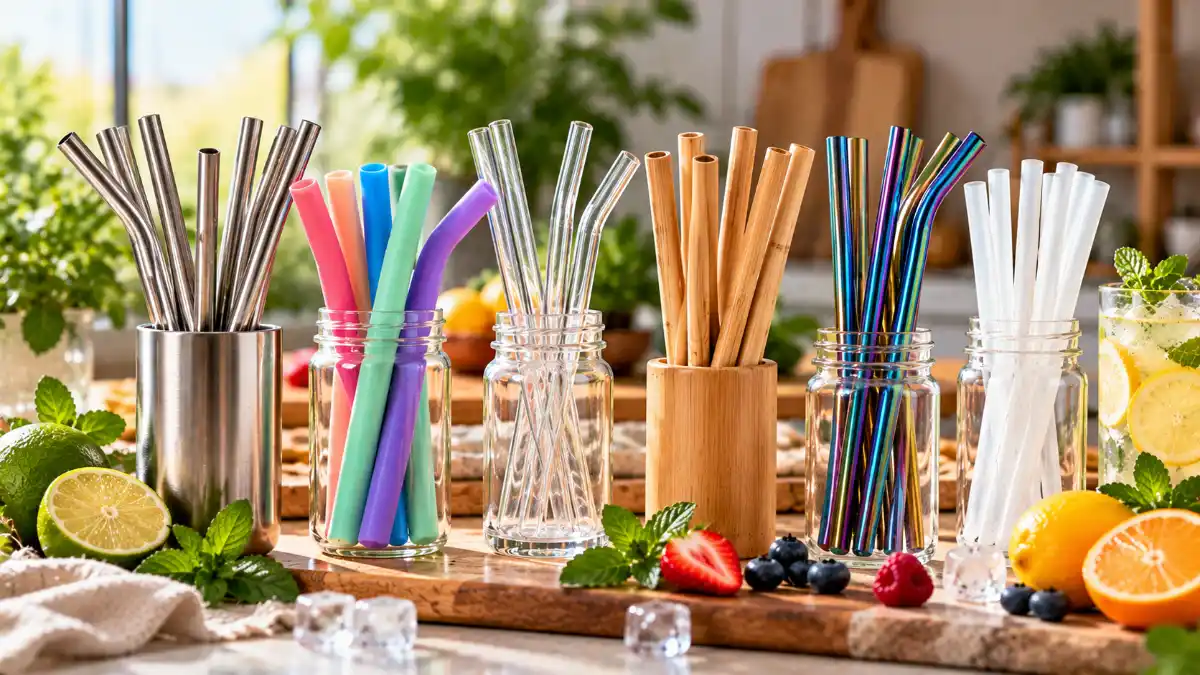
The materials of some kind of reusable straw are usually silicone, stainless steel, silica, borosilicate glass, bamboo, titanium, reusable plastic straw, or a combination. From flexibility + durability (general and UV light), to cleaning, breakage resistance, heat response & drinkability – every style is different.
Of course, the material does matter; but that is only one of the criteria for how a straw is made. The straw will appear to be whatever size and material your drink of choice might need (a tiny stainless-steel straw is perfect for water, horrific when it comes to a thick smoothie). Although not lower maintenance than glass or metal – it’ll require more specialized care – it feels so much like a natural thing.
While reusable straws can be made of a variety of materials, this primer takes apart what those actually are (and how they compare and contrast), which is best for which kinds of drinks, some printable shopping pointers to keep in mind before pulling out your wallet if you’re stateside, and when one should “throw it in the trash,” as the expression goes.
| Material | What it is | Main advantage | Main consideration |
| Stainless steel | Iron-based alloy containing chromium | Durable | Rigid |
| Silicone | Flexible silicone polymer/elastomer | Soft and flexible | Quality varies |
| Glass | Usually borosilicate glass | Easy to inspect | Breakable |
| Bamboo | Natural bamboo | Natural construction | Must dry thoroughly |
| Titanium | Lightweight metal | Durable and light | Higher price |
| Reusable plastic | Food-contact polymer | Lightweight | Can scratch or wear |
| Hybrid | Combination of materials | Combines properties | More parts to clean |
What Is a Reusable Straw Made Of?
A reusable straw is not one standardized product. Manufacturers use different materials depending on whether the goal is durability, flexibility, portability, transparency, low weight, or a particular drinking feel.
Understanding the material’s composition and physical behavior is more useful than simply choosing whatever is labeled “eco-friendly.”
Stainless Steel Reusable Straws
This ferrous alloy is famous for its ability to withstand corrosion and has a minimum chromium content. This is why it›s important that sellers verify manufacturer specs; cause as you will notice, product listings go by grades, such as 304 or 316, but not all steel straws are created equal.
Mainly, stainless steel is a top selection with tough sunshades, ideal for daily lifestyle and go. So we should go with steel because a burger tumbler coworker may be in and out of a bag.
The trade-off is rigidity. It’s metal and therefore also able to react to heat & drink straw can be cold in cold drinks or hot when used for drinking a warm liquid.
Inspect the drinking end periodically. If the rim of the metal straw has badly scratches/abrasion or you just feel unsafe, stop using it.
- Read more: What Is a Reusable Straw Made Of
Silicone Reusable Straws
Silicone straws are made from silicone-based polymers or elastomers. They are flexible rather than rigid and usually provide a softer mouthfeel than metal or glass.
That flexibility can make silicone convenient for travel, collapsible kits, and people who dislike biting or touching hard metal.
Not all silicone products are identical, however. Formulation, wall thickness, manufacturing quality, and finishing can differ by manufacturer. Some silicone products can also retain noticeable odors after repeated contact with strongly flavored drinks.
Check the manufacturer’s instructions before using a silicone straw with very hot liquids or placing it in a dishwasher. A material category alone does not establish the temperature limit of every finished product.
Borosilicate Glass Straws
Many glass drinking straws are made from borosilicate glass, although shoppers should confirm the actual material stated by the manufacturer.
Borosilicate glasses are formulated with thermal properties that differ from ordinary soda-lime glass. Corning’s published data for its borosilicate compositions, for example, show relatively low coefficients of thermal expansion, although exact properties vary by formulation.
The practical advantage of glass is transparency. You can see inside the straw after washing and check whether smoothie, juice, or other residue remains.
Glass also provides a smooth drinking surface, but breakage remains its major disadvantage. Inspect a glass straw before use and replace it immediately if you find a crack, chip, or damaged rim.
Bamboo Reusable Straws
Bamboo straws are made from naturally derived bamboo rather than molded polymer or metal. Because bamboo is a grown material, individual pieces can vary somewhat in appearance and internal diameter.
Bamboo is lightweight and may appeal to people who prefer naturally derived kitchen products, but it usually needs more attention to drying and storage.
Think of a bamboo straw somewhat like a wooden kitchen utensil: leaving it damp in an enclosed space is not a good habit. Wash it according to the manufacturer’s instructions and let it dry thoroughly before storing it.
Check regularly for splitting, cracking, unusual odors, discoloration, or mold. A deteriorated bamboo straw should be replaced.
Titanium Reusable Straws
Titanium is a more specialized reusable straw material. It combines low weight, durability, and strong corrosion resistance, making it appealing for travel, camping, or users who want a lightweight metal option.
Its main disadvantage is price. Stainless steel generally provides ample durability for everyday drinking at a lower cost, so titanium makes the most sense when low weight or the specific material itself is important to the buyer.
Titanium is still rigid, so the same physical precautions that apply to other hard drinking straws remain relevant.
Reusable Plastic Straws
“Plastic” describes a broad family of materials rather than one single substance.
Reusable drinking straws may use polymers such as polypropylene (PP), polyethylene (PE), or another material specified by the manufacturer. Their exact properties depend on the polymer, additives, construction, and intended conditions of use.
Plastic reusable straws are often inexpensive, lightweight, and resistant to shattering. With repeated use, however, some may become scratched, cloudy, cracked, or deformed.
A BPA-free label should not be treated as a complete description of a plastic product. It addresses BPA, but it does not tell you every detail about the polymer, additives, durability, temperature range, or intended use.
Hybrid Reusable Straws
Some products combine multiple materials.
Examples include:
- stainless steel with a silicone drinking tip;
- collapsible silicone stored inside a metal case;
- a rigid straw body with a removable soft mouthpiece;
- telescoping metal travel straws.
Hybrid construction can combine useful qualities such as durability and a softer mouthfeel.
The downside is complexity. Removable tips, joints, telescoping sections, and carrying cases create additional surfaces that need to be washed, dried, and inspected.
Reusable Straw Materials Compared
The table below provides a practical comparison rather than declaring one material universally best.
| Material | Flexibility | Durability | Breakage concern | Cleaning | Travel | Main drawback |
| Stainless steel | Low | High | Low | Easy | Excellent | Rigid |
| Silicone | High | Good | Very low | Moderate | Excellent | May retain odors |
| Glass | Low | Good if protected | High | Easy | Moderate | Can break |
| Bamboo | Low | Moderate | Can split | More care | Good | Must dry fully |
| Titanium | Low | Very high | Low | Easy | Excellent | Higher cost |
| Reusable plastic | Varies | Varies | Low | Easy | Excellent | Scratching/wear |
Avoid fixed claims such as “this material lasts exactly 10 years.” Useful life depends on construction quality, frequency of use, cleaning, impacts, storage, and signs of deterioration.
What Does “Food-Grade” Mean for a Reusable Straw?
“Food-grade” sounds reassuring, but the phrase should not replace meaningful product information.
Why the Material Name Is Not Enough
For U.S. food-contact materials, FDA explains that the regulatory status of a finished food-contact material depends on the regulatory status of the individual substances that make it up. Authorizations can also include specifications and limits on conditions of use.
In other words, seeing only:
- “stainless steel,”
- “silicone,” or
- “plastic”
does not tell you everything about a finished straw.
Look for the manufacturer, material details, intended use, temperature guidance, and cleaning instructions.
What “BPA-Free” Does and Does Not Tell You
A BPA-free claim concerns bisphenol A. It should not be interpreted as a complete evaluation of every substance in a product.
It does not, by itself, tell you:
- which polymer was used;
- whether other additives are present;
- the product’s temperature limits;
- how durable it will be;
- whether it is suitable for every food-contact condition.
Treat BPA-free as one product attribute rather than a universal safety certificate.
What U.S. Buyers Should Check
Before purchasing, check:
- Exact material is identified
- Manufacturer or brand is clear
- Straw length is listed
- Internal diameter is listed
- Temperature guidance is available
- Cleaning instructions are provided
- Dishwasher guidance is stated
- Drinking edge looks smooth and finished
- Replacement or damage guidance is available
- Food-contact claims are supported by meaningful product information
FDA’s food-contact framework explicitly distinguishes different food types and conditions such as room-temperature, refrigerated, hot-filled, boiling-water, and higher-temperature uses.
Chemical Safety vs Physical Safety
Material chemistry and physical safety are different questions.
A chemically stable material can still be rigid or breakable, while a soft material still needs appropriate cleaning and product verification.
Rigid Straw Materials
Stainless steel, titanium, and glass are rigid.
That can be useful because they hold their shape, but rigid objects can cause injury if someone falls while the straw is in the mouth. Glass introduces the additional possibility of cracking or breaking.
A U.S. emergency-department study covering 2012–2021 identified 1,174 straw-related injury cases in the analyzed dataset. Children ages three and younger accounted for 43.8% of the cases, and poking was the most common mechanism. The authors particularly cautioned about reusable rigid straws in young children.
Flexible Straw Materials
Silicone provides a softer, flexible alternative.
Its advantages can include:
- softer mouthfeel;
- easy packing;
- collapsibility;
- low breakage concern.
Flexibility, however, does not make cleaning optional. The internal channel still needs to be washed thoroughly and allowed to dry.
Reusable Straws for Children
For children, consider both the material and how the product will be used.
Good practices include:
- following manufacturer age guidance;
- supervising young children;
- inspecting the straw for damage;
- avoiding walking or running with a rigid straw in the mouth;
- considering a flexible design when appropriate.
The goal is not to label one material universally “safe” or “unsafe,” but to match the product to the user and situation.
Which Reusable Straw Is Best for Different Drinks?
The right internal diameter can matter as much as the material.
| Drink | Key requirement | Straw type to consider |
| Water | Easy flow | Standard |
| Soda | Standard flow | Standard |
| Iced coffee | Length + durability | Standard/long |
| Smoothie | Thick consistency | Wide |
| Milkshake | Very thick consistency | Wide/extra-wide |
| Juice | Normal flow | Standard |
| Boba | Tapioca pearls | Extra-wide |
| Hot beverage | Temperature suitability | Manufacturer-rated |
Why Straw Diameter Matters
Imagine buying a beautifully finished stainless-steel straw and discovering that your breakfast smoothie barely moves through it.
The problem is not the steel. It is the opening.
As drinks become thicker or contain larger solids, a wider internal diameter becomes more important. Think:
Standard → Wide → Extra Wide → Boba
Check actual product dimensions rather than relying only on labels such as “smoothie straw.”
Why Straw Length Matters
Length determines whether the straw fits comfortably in the container.
Consider:
- cans;
- regular drinking glasses;
- mason jars;
- travel tumblers;
- tall insulated cups.
Measure your most-used cup before purchasing an unusually long or short straw set.
How to Choose a Reusable Straw in 6 Steps
Step 1 – Choose the Material
Decide whether you prioritize:
- durability;
- flexibility;
- low breakage concern;
- transparent construction;
- natural texture;
- easy maintenance.
Step 2 – Choose the Diameter
Match width to the beverage:
- water or soda: standard;
- smoothie: wide;
- milkshake: wide or extra-wide;
- boba: extra-wide.
Step 3 – Measure the Length
Measure the cup or tumbler you use most often. Product photos alone can make straw length difficult to judge.
Step 4 – Check Temperature Guidance
Do not assume a straw intended for cold drinks is appropriate for very hot beverages. Follow the manufacturer’s stated conditions of use.
Step 5 – Check Cleaning Requirements
Ask:
- Will a cleaning brush reach the entire interior?
- Is the straw straight or curved?
- Can you see inside it?
- Can all components dry completely?
Step 6 – Review Manufacturer Information
Marketing words such as premium, natural, eco-friendly, food-grade, and BPA-free should not replace actual specifications.
Choose products that clearly describe their material, size, intended use, and care requirements.
Quick Reusable Straw Buying Checklist
Before ordering, confirm:
- Material
- Internal diameter
- Length
- Flexibility
- Intended beverage temperature
- Cleaning method
- Dishwasher guidance
- Smooth drinking edge
- Storage requirements
- Manufacturer information
How to Clean a Reusable Straw Properly
Reusable products only remain practical when they can be cleaned reliably.
Everyday Cleaning Method
- Rinse the straw soon after use.
- Use warm water and suitable dish soap.
- Insert an appropriately sized cleaning brush.
- Scrub through the complete internal channel.
- Rinse thoroughly.
- Inspect the interior and both ends.
- Allow the straw to dry completely before storage.
Follow product-specific washing instructions when they differ from this general routine.
Cleaning Smoothies and Milkshakes
Thick residue becomes harder to remove after it dries.
If you use your straw for smoothies, protein drinks, or milkshakes, rinse it soon after finishing. A wide brush that matches the straw’s internal diameter is generally easier to use than a brush that barely contacts the walls.
Dishwasher vs Hand Washing
Dishwasher compatibility is a property of the finished product, not something that should be assumed solely from the material name.
Follow the manufacturer’s instructions, especially for:
- silicone;
- plastic;
- bamboo;
- products with adhesives or multiple components.
Drying and Storage
Let a straw dry completely before putting it into an enclosed carrying case.
This matters particularly for bamboo and other materials where trapped moisture can contribute to deterioration. A reusable travel case is useful only when the straw stored inside it is clean and dry.
When Should You Replace a Reusable Straw?
Reusable does not mean permanent.
| Material | Inspect for | Replace when |
| Stainless steel | Damaged rim, severe dents, corrosion | Edge or structure is compromised |
| Silicone | Tears, tackiness, deterioration | Material noticeably degrades |
| Glass | Chips or cracks | Any structural damage appears |
| Bamboo | Mold, splitting, cracks | Mold or deterioration develops |
| Titanium | Damaged edge | Structural integrity is compromised |
| Plastic | Deep scratches, cracks, deformation | Significant wear develops |
Condition is usually more useful than an arbitrary calendar schedule.
Are Reusable Straws Better for the Environment?
Reusable straws can reduce dependence on single-use products, but “reusable” does not automatically mean “zero impact.”
Reuse Frequency Matters
A reusable product delivers its intended benefit only when it is actually reused.
Buying several reusable straws and frequently replacing them defeats part of the purpose. A well-maintained straw that becomes part of your normal routine is more useful than one that sits unused in a drawer.
Manufacturing and Transport Matter
Environmental impact can include:
- raw-material extraction;
- manufacturing;
- packaging;
- transportation;
- washing;
- product lifespan;
- disposal or recycling.
Because lifecycle results depend on these assumptions, avoid universal claims that one straw material is always the “greenest.”
Reusable vs Recyclable vs Biodegradable
These terms are different:
Reusable: designed to be used repeatedly.
Recyclable: capable of being processed into another material where suitable infrastructure exists.
Biodegradable: capable of biological breakdown under appropriate conditions.
A product may be reusable without being easily recyclable, or biodegradable without being designed for years of reuse.
What Competitor Guides Usually Miss About Reusable Straws
Material names are useful, but they do not tell the whole story.
Two Straws Made From the Same Material Can Be Very Different
Two stainless-steel straws can differ in:
- wall thickness;
- internal diameter;
- surface finish;
- length;
- edge quality;
- construction.
The same principle applies to silicone, glass, bamboo, titanium, and plastic.
A material label tells you what the product is broadly made from-not whether its dimensions and finish are right for you.
Diameter Can Matter More Than Material
For a smoothie drinker, choosing between silicone and steel may be less important than making sure either straw is wide enough.
Start with the function first, then compare materials within the correct size.
Mouthfeel Matters
Material changes how drinking feels.
Metal: hard and rigid.
Silicone: soft and flexible.
Glass: smooth and rigid.
Bamboo: more natural and textured.
This is subjective, but it can strongly influence whether someone actually enjoys using the product every day.
Use the Look → Feel → Smell → Clean Test
A simple inspection takes only a moment.
Look: Check for cracks, chips, mold, deformation, or unusual discoloration.
Feel: Check for rough edges, sharp areas, stickiness, or deterioration.
Smell: Notice persistent unusual odors after cleaning.
Clean: Confirm the entire internal channel can be cleaned and is free from visible residue.
Common Mistakes When Buying or Using Reusable Straws
Avoid these common mistakes:
- Buying a narrow straw for thick smoothies.
- Ignoring the height of your usual tumbler.
- Choosing only by material name.
- Continuing to use chipped or cracked glass.
- Putting damp bamboo into enclosed storage.
- Washing only the outside of the straw.
- Treating “eco-friendly” as a complete product specification.
- Assuming BPA-free explains the entire material formulation.
- Ignoring manufacturer temperature guidance.
- Choosing a rigid straw without considering who will use it and how.
Which Reusable Straw Material Should You Choose?
There is no universal winner. Match the product to your priorities.
| Priority | Material/type to consider |
| Durability | Stainless steel or titanium |
| Flexibility | Silicone |
| Visible cleanliness | Glass |
| Naturally derived material | Bamboo |
| Travel | Silicone or lightweight metal |
| Smoothies | Wide steel, silicone, or glass |
| Boba | Extra-wide straw |
| Lower breakage concern | Silicone or metal |
| Easy visual inspection | Glass |
| Soft mouthfeel | Silicone |
Frequently Asked Questions
What reusable straw are made of?
So, most reusable straws are made of: stainless steel, silicone rubber, borosilicate glass (which implies it is really lead-free glass), bamboo wool fibers, titanium,r plastic, or a piece of furniture manufactured from those goods together. Each has its perks: Flexibility, longevity, preservation, and drinkability.
What Are Metal Reusable Straws Made Of?
Reusable metal straws are primarily made of stainless steel. The only other is titanium, which comes at a premium. However, not all metal is the same, me and you will ultimately need to look up the material spec from the manufacturer.
I mean, is silicone plastic?
Non-silicone elastomers Q18: unlike silicone, are softer and have a very different response to heat and mechanical stress compared with common thermoplastic resins such as polypropylene.
These reusable straws are composed of borosilicate glass, a low-expansion glass engineered to resist sudden temperature changes without breaking.
Most of these ‘borosilicate’ glass (treated, that is) straws tout themselves as being reusable. Although borosilicate formulas are also famous for their relatively small thermal expansion, the final consumer should be sure what specific material the manufacturer measured and the instructions for using it.
Are reusable plastic straws?
Some are. Plastic straws are composed of various types of polymers like polypropylene or polyethylene polymers, or other produced variants. In reality, the parameters of temperature and strength are almost entirely dictated by the final product.
Silicone Vs.
Neither is universally better. The silicone is a good compromise: firm, but still gives slightly as it also absorbs shock-this way you get the structure and rigidity from the stainless steel, with all that softness for your mouthfeel. It all depends on what you are sipping, where you are headed, and how cozy (with air or without) you feel.
Mould on Some Bamboo Reusable Straws Mike Campbell Follow Apr 10 · 7 min read
Similarly, like timber (wood), bamboo can begin to get moldy or rot if the climate is too moist and there is no proper care. Clean the straw and its complete drying out, replacement if there is any trace of visible mold, cracks, or high-level degradation.
Best reusable straw for smoothies?
The super wide inside diameter is really THE BEST feature for smoothies, folks! Whichever way you go, make sure that the mouth is at least as wide as the thickness of a drink, so either stainless steel or glass is good. Or silicone – but your mileage may vary with this on reviews – all up in the air.
Reusable straw replacement frequency
There is no universal schedule. If the straw is a piece of broken glass, bamboo, shiny black metal, silicone, filthy or nasty, rusty, chipped, or dented plastic, you need to replace it.
Which reusable straw is easiest to clean?
The surface is so smooth that glass straws and stainless steel straws are typically almost impossible to clean, because residues remain visible on the frosted side of the clear material of the glass. Think Further, What more Elite on Outer or Inner Form (Also Let Not to forget Material which does matter too) So Tha t Inside Diameter along Side Curves also Will matter Included Removable Inner as Most Important& Easy Clean Brush then Simple Material.