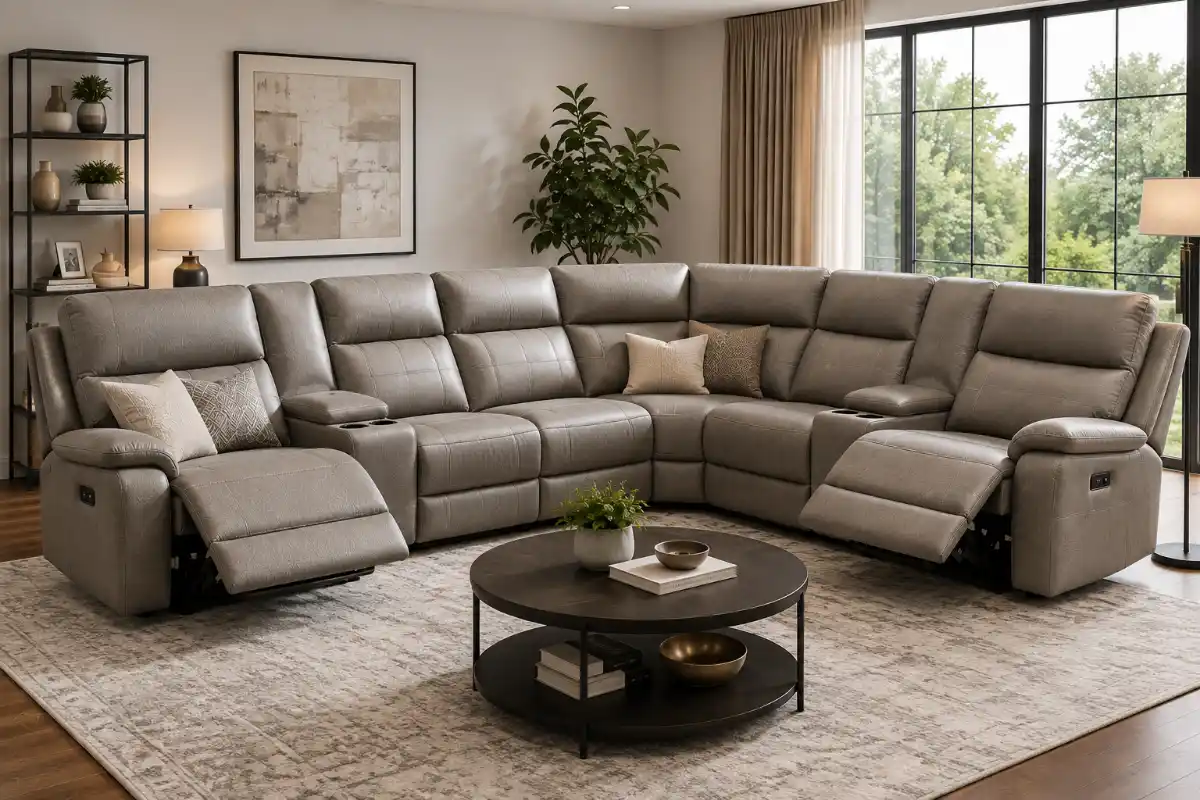
Reclining Sectional: The Complete 2026 Buying Guide
A reclining sectional combines the flexible, multi-seat layout of a sectional sofa with built-in recline functionality, giving every seat the ability to kick back independently. It’s the go-to choice for households that want a dedicated movie-night or lounging setup without sacrificing seating capacity – but choosing the right one means balancing size, mechanism type, materials, and room layout before you buy.
This furniture category isn’t a one-size-fits-all purchase. The right pick depends on your room dimensions, how many people regularly use the space, and whether you need power convenience or manual reliability. This guide breaks down everything you need to know – from mechanism types and space planning to materials and maintenance – so you can shop with confidence instead of guesswork.
What Is a Reclining Sectional?
A reclining sectional is a multi-piece sofa system where one or more sections include a reclining mechanism, allowing individual seats to tilt back and extend a footrest independently of the rest of the sofa. Unlike a standard sectional, where every seat stays fixed, this design lets each person adjust their own seating position – some models recline every seat, while others reserve the feature for end sections or a single loveseat unit within the layout.
This hybrid design merges two separate furniture categories: the traditional recliner chair and the modular sectional sofa. Combining them solves a common living-room problem – a recliner alone rarely offers enough seating for a family or friend group, while a standard sectional doesn’t match the same lounging comfort.
Power vs. Manual Reclining Mechanisms
The reclining mechanism is the first major decision point, and it affects price, maintenance, and placement options.
| Feature | Power Reclining Sectional | Manual Reclining Sectional |
| Operation | Button-activated motor | Pull lever or push-back motion |
| Power source | Requires a nearby electrical outlet | None needed |
| Typical price | Higher (often $1,800-$4,000+) | Lower (often $800-$1,800) |
| Extra features | Often includes USB ports, adjustable headrests, and massage/heat | Fewer built-in extras |
| Long-term maintenance | Motor and wiring can require repair | Fewer mechanical parts to fail |
| Best for | Tech-focused households, accessibility needs | Budget-conscious buyers, flexible placement |
Power models have become the dominant choice in mid-to-premium sectionals because they pair recline motors with conveniences like wireless charging pads, adjustable power headrests, and heat-and-massage functions. Manual mechanisms remain a smart choice if you want to avoid cords entirely or place the sofa somewhere without easy outlet access.
- Read more: Reclining Sectional
How to Measure Your Room for a Reclining Sectional
Before buying, measure both the sofa’s footprint and the clearance it needs to recline – these sectionals typically require more depth than standard sofas because the footrest extends outward.
Follow these steps to avoid a piece that overwhelms your room or can’t fully recline:
- Tape off the exact width and depth dimensions on your floor to visualize the footprint before buying.
- Leave at least 3 feet of walkway space in traffic paths around the sofa.
- Allow roughly 18 inches of clearance between the seating and your coffee table.
- Check the space behind the sofa – traditional recline mechanisms need several feet of clearance, while wall-hugger (zero-clearance) designs need as little as 3-5 inches.
- Confirm outlet placement if you’re choosing a power model, since cords running across walkways create a tripping hazard.
Wall-Hugger and Zero-Clearance Designs
If floor space is limited, a wall-hugger design (also called zero-wall or zero-clearance) solves the biggest space objection to this furniture category. These models use a sliding seat mechanism that shifts the entire seat forward as it reclines, rather than requiring open space behind the backrest. That means you can push the piece almost flush against a wall and still recline fully – a meaningful advantage in apartments, smaller living rooms, or basements with limited layout flexibility.
Choosing the Right Configuration and Layout
Options come in L-shaped, U-shaped, chaise, and fully modular configurations, and the right layout depends on your room shape and how many people typically sit down at once.
- L-shaped layouts fit naturally into corners and work well in most standard living rooms, maximizing seating without consuming the center of the room.
- Modular designs are made of individual pieces that you can rearrange or reconfigure over time, useful if you move often or want to adapt the layout for different occasions.
- Chaise-end layouts replace one full reclining section with an extended chaise, which can look sleeker and take up less depth than a full recliner end.
- Loveseat-style units offer two independent recliners with a shared console in between, ideal for couples or smaller households that still want the sectional look.
When comparing configurations, check whether the recline feature applies to every seat or only the end units – some budget-friendly models only recline the two end sections while the middle stays fixed, a practical trade-off if not everyone in the household wants to recline simultaneously.
Materials and Durability
Performance fabrics, top-grain leather, and high-density foam cushions are the most reliable indicators of long-term durability, particularly in households with children or pets.
| Material | Durability | Best For |
| Performance fabric (stain-resistant polyester/microfiber blends) | High – resists stains, easy to clean | Families, pet owners |
| Top-grain leather | High, but shows wear over time | Households prioritizing a polished look |
| Faux leather | Moderate – prone to cracking with heavy use | Budget buyers, lower-traffic rooms |
| Chenille | Moderate to high – soft texture, less prone to a dated look | Style-focused buyers |
| Olefin | High – colorfast, resists fading | Sunlit rooms |
Beyond upholstery, check the frame construction and cushion fill. A corner-blocked hardwood or steel frame with high-density polyurethane foam cushions holds its shape far longer than lower-cost builds on particleboard frames with standard foam. Recline mechanisms themselves also vary in quality – steel-reinforced components tend to operate more smoothly and last longer than lighter-duty parts found in entry-level models.
Features Worth Prioritizing
Not every added feature is worth paying extra for, but several have become genuinely useful upgrades rather than gimmicks:
- Adjustable power headrests – let you fine-tune neck support independent of the recline angle, particularly useful for taller users.
- USB and USB-C charging ports – built into the console or armrest, eliminating the need for extension cords near seating.
- Storage consoles – hidden compartments between reclining seats that hold remotes, blankets, or chargers.
- Cup holders – pop-out or fixed holders that reduce spill risk, a practical addition for movie-night use.
- Heat and massage settings – available on premium power models, though they add to both cost and long-term repair complexity.
- Wireless charging pads – built into console armrests on some higher-end models.
Prioritize features based on actual household habits rather than the longest spec sheet – a family with young children may value stain-resistant fabric and storage far more than heat-and-massage functions.
Common Buying Mistakes to Avoid
- Skipping in-person testing. Comfort is subjective, and cushion firmness that feels supportive to one person may feel too hard to another. Sit on the piece (or a similar floor model) before committing, especially for larger purchases.
- Ignoring recline clearance. Buying a traditional recline mechanism without checking the space behind it is one of the most common regrets among buyers.
- Underestimating delivery and assembly needs. Large, multi-piece units often require white-glove delivery or professional assembly – factor this into your budget and timeline.
- Choosing color before testing durability. A light-colored fabric may look appealing in a showroom, but show stains quickly in a high-traffic family room; performance fabrics in that same shade solve this problem.
- Overlooking power access. A power model placed away from an outlet will need a visible extension cord, undermining the clean look you’re likely trying to achieve.
Maintaining a Reclining Sectional
Regular vacuuming, prompt spill cleanup, and following the manufacturer’s specific fabric-care instructions are the most effective ways to keep this furniture looking new. Use a vacuum with an upholstery attachment weekly to remove debris from seams and consoles, where crumbs and dust tend to accumulate near cup holders. For fabric models, a fabric-safe cleaner and a lint roller handle most everyday messes; leather and faux-leather versions generally require a dedicated leather cleaner rather than standard upholstery products. Always check the care tag before applying any cleaning product, since incorrect cleaners can damage certain performance fabrics.
Frequently Asked Questions
How much does a reclining sectional typically cost?
Prices generally range from around $800 for compact manual models to $4,000 or more for large power units with premium materials and features like heat, massage, or leather upholstery. Mid-range power models with USB ports and storage consoles commonly fall between $1,800 and $2,800. Cost depends heavily on size, mechanism type (power costs more than manual), fabric quality, and brand. Sales events and clearance configurations can bring costs down significantly, so comparing across retailers before purchasing is worthwhile.
Can a reclining sectional fit in a small living room?
Yes, several designs are built specifically for smaller spaces, including wall-hugger (zero-clearance) models, apartment-sized units in the 75-85 inch width range, and compact L-shaped configurations. The key is prioritizing a recline mechanism that doesn’t need extra depth behind the sofa, since traditional recliners require several feet of open space to fully extend. Measuring your room and taping off the footprint beforehand helps confirm fit before you commit to a purchase.
Do reclining sectionals need to be plugged in?
Only power models require an electrical outlet, since the recline motor, headrests, USB ports, and any heat or massage features run on electricity. Manual versions operate entirely through a lever or push-back mechanism and need no power source at all, making them more flexible for placement in rooms without nearby outlets. If you choose a power model, plan its placement around your room’s existing outlets to avoid visible extension cords.
What is the difference between a reclining sectional and a regular recliner chair?
A reclining sectional is a multi-seat sofa system with built-in recline functionality across some or all of its sections, while a recliner chair is a single-seat unit. Sectionals suit households needing seating for multiple people who each want independent recline control, whereas standalone recliner chairs work better for individual use or smaller spaces where a full sectional isn’t practical. Many buyers combine both – a sectional for the main seating area and a standalone recliner as an accent chair.
How long does a reclining sectional typically last?
With regular use and proper care, a well-built unit with a quality frame and reinforced recline mechanism can last 8 to 15 years, though the exact lifespan depends heavily on build quality, upholstery material, and how frequently the recline function is used. Steel-reinforced mechanisms and corner-blocked hardwood frames tend to outlast lower-cost alternatives built on lighter frames. On power models, the motor is typically the first component to require repair or replacement, especially with heavy daily use.
Are leather or fabric options better for pets and kids?
Performance fabrics – stain-resistant polyester or microfiber blends – are generally the most practical choice for households with pets or kids, since they resist stains, clean easily, and hold up to frequent use without showing wear quickly. Leather is durable and easy to wipe clean, but it can show scratches from pet claws and may crack over time with heavy use. Faux leather sits between the two, offering easier cleanup than fabric but less long-term durability than genuine leather or performance fabric.
What size do I need for my living room?
There’s no universal size – it depends on your room’s dimensions and expected seating capacity, but a useful rule of thumb is leaving at least 3 feet of clearance in walkways and around the reclining footprint. Compact units (75-85 inches wide) suit apartments and smaller living rooms, while larger L-shaped or modular configurations (120 inches or more) fit family rooms designed around a central seating and media area. Taping off the exact dimensions on your floor before buying is the most reliable way to confirm fit.
Is a wall-hugger design worth choosing over a traditional recliner?
If floor space is limited, yes – a wall-hugger (zero-clearance) design lets you place the sofa just a few inches from the wall while still reclining fully, compared to traditional recliners that need several feet of open space behind them. The trade-off is that wall-hugger mechanisms use a sliding-seat design that shifts the whole seat forward as it reclines, which some buyers find changes the seating position slightly compared to a standard recline. For small living rooms, apartments, or basements with limited layout flexibility, the space savings generally outweigh this minor adjustment.
Do power recline mechanisms require special maintenance for the motor?
Power mechanisms generally need minimal maintenance beyond occasional inspection of the electrical connections and avoiding overloading the motor with excess weight or force. Most manufacturers recommend not forcing the mechanism if it becomes stuck and instead checking the power connection or contacting customer support, since forcing a jammed motor can cause lasting damage. Keeping the area around the mechanism free of dust and debris also helps prevent operational issues over time.
Can I mix a reclining sectional with non-reclining furniture in the same room?
Yes, pairing this style of seating with a non-reclining accent chair, ottoman, or console table is a common styling approach that adds visual variety without sacrificing comfort benefits. Designers often recommend keeping accent pieces in a complementary but distinct fabric or color to avoid a monotonous look, while maintaining a shared color palette for cohesion. This approach also works well practically, since not every room needs every seat to recline, especially in shared or multi-use living spaces.
What’s the difference between a chaise-end and a loveseat-style layout?
A chaise-end layout replaces one full reclining section with an extended chaise, offering a sleeker profile and slightly less depth than a full recliner end, while a loveseat-style layout provides two independent recliners with a shared storage console between them. Chaise-end designs suit buyers who want one relaxed lounging spot alongside standard seating, while loveseat-style units work better for couples or smaller households that want two fully independent recline positions. Both configurations are typically available across power and manual mechanisms.