

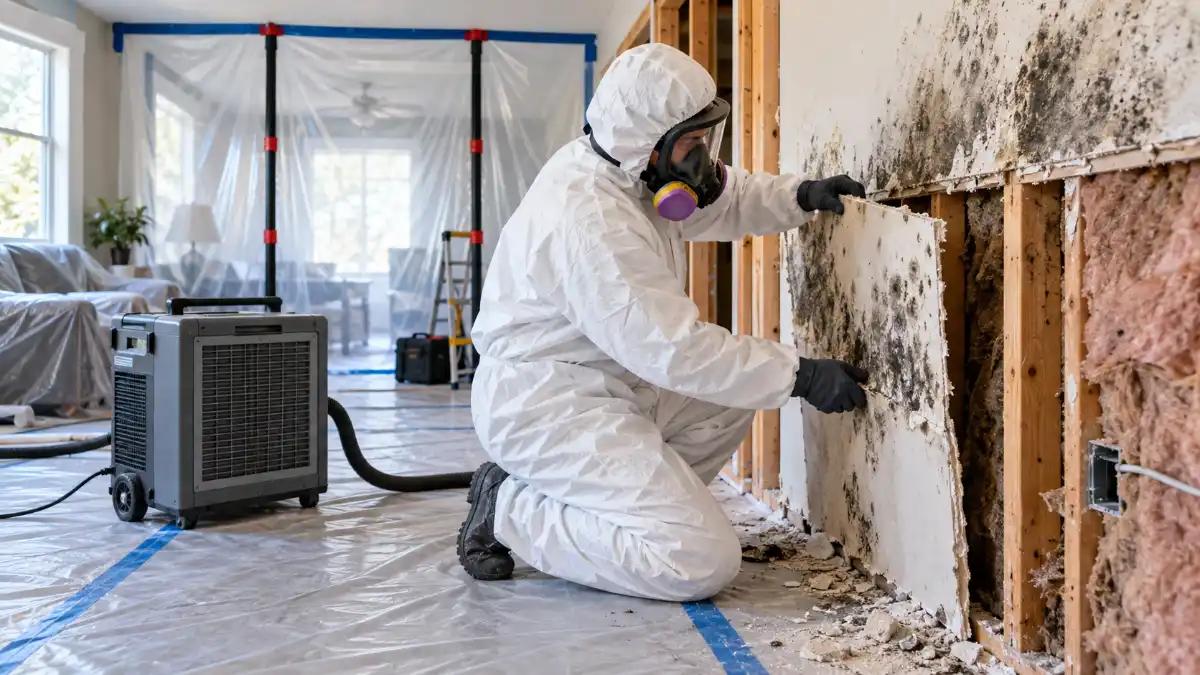
In small amounts, it might seem like merely a normal cleaning difficulty with no great deal of concern. You see an ugly stain by the shower, and you spray it with a household cleaner, wipe the surface, and think that problem is solved!
Weeks later, that stain comes back.
Why does this happen?
By and large,e the issue is not actually with how it gets cleaned. It is the moisture source that never got fixed.
The other errors can be more severe. Disturbing contaminated drywall without appropriate safeguards can drive particles into clean rooms. If you can not properly clean contaminated materials, then keeping them can leave contamination behind.
You cannot select the best solution for mold remediation unless you first know what the problem is.
This guide breaks down 11 of the most common mistakes, why they are important,nt and how homeowners can start making better decisions around cleaning, hiring professionals, and avoiding problems in the long run.
Before You Start: Understand the Extent of the Problem
Not every mold problem requires the same response.
A small amount of growth on accessible bathroom tile is different from extensive contamination inside a flooded basement.
Before cleaning, consider four important questions.
Where Is the Mold Located?
Look at the affected surface and surrounding materials.
Growth on glass, metal, or ceramic tile may be easier to address than contamination within carpet, insulation, or drywall.
Hidden moisture can also affect materials beyond the visible stain.
- Read more: Mold Remediation
How Large Is the Affected Area?
The EPA indicates that homeowners can handle many mold problems smaller than approximately 10 square feet.
However, extensive water damage, contamination within HVAC systems, or other complicating conditions may require professional assistance regardless of the visible size.
What Caused the Moisture?
Try to establish whether the source is a leaking pipe, water intrusion, condensation, flooding, or another problem.
If the source remains active, cleanup alone is unlikely to provide a lasting solution.
Who Might Be Exposed?
Consider occupants with asthma, allergies, chronic lung disease, or immune suppression.
The CDC advises individuals in these groups against participating in mold cleanup.
For extensive contamination, the work area may need to be isolated from occupied spaces.
Mistake 1: Removing Visible Mold Without Repairing the Leak
The most important problem to address is moisture.
Imagine discovering mold beneath a kitchen sink.
You clean the cabinet floor and remove the visible stain, but the drain connection continues leaking.
The wood remains damp, and new growth eventually appears.
The original cleanup addressed the symptom rather than the cause.
How to Avoid This Mistake
Inspect the affected area and identify the source of water.
Arrange the necessary plumbing, roofing, drainage, or ventilation repairs.
Evaluate whether moisture has reached concealed materials.
Cleaning should be coordinated with correcting the underlying water problem.
The EPA identifies moisture control as the key to preventing indoor mold growth.
Mistake 2: Assuming All Black Mold Is the Same
Many homeowners associate dark-colored growth with a particular dangerous species.
However, mold color alone cannot reliably identify its species or establish its health risk.
Different types of mold can have similar appearances.
Likewise, lighter-colored growth should not automatically be considered harmless.
What Should You Do Instead?
Concentrate on the actual building problem.
Document the visible growth, investigate moisture, and determine the appropriate cleanup method.
Do not delay obvious repairs while attempting to identify mold through internet photographs.
If laboratory identification is needed for a specific reason, use a qualified professional who can explain the purpose and limitations of the test.
Mistake 3: Using Bleach as a Universal Solution
Bleach is frequently recommended in informal cleaning advice.
However, mold cleanup is not simply a matter of applying a chemical.
The EPA does not recommend routine use of bleach or other biocides during mold remediation. Even dead mold can cause allergic reactions, so contaminated material must be physically removed.
A chemical product also cannot repair a leak or restore deteriorated building materials.
A More Appropriate Cleaning Approach
For a limited problem on a suitable hard surface, EPA guidance supports cleaning with detergent and water, followed by thorough drying.
Wear appropriate protection and follow product instructions.
Different materials require different methods, and extensive contamination may require professional work.
Never combine bleach with ammonia, acids, or other cleaning products.
The CDC advises following chemical safety instructions and ensuring adequate ventilation when cleaners are used.
Mistake 4: Painting Over Mold
Painting is sometimes used to hide discoloration.
It may temporarily make a wall appear cleaner, but it does not necessarily remove underlying contamination.
If the wall remains damp, paint may peel or fail.
Why Surface Appearance Is Not Enough
A contaminated wall may require cleaning or partial removal, depending on its condition.
The moisture source must also be corrected.
Only after suitable cleanup and drying should refinishing begin.
Mold-resistant paint may be useful in appropriate applications, but it is not a substitute for resolving an active mold problem.
Mistake 5: Spreading Contamination During Cleanup
Cleaning and demolition can disturb contaminated dust.
Using powerful household fans or moving contaminated materials through occupied rooms without precautions can increase the risk of spreading particles.
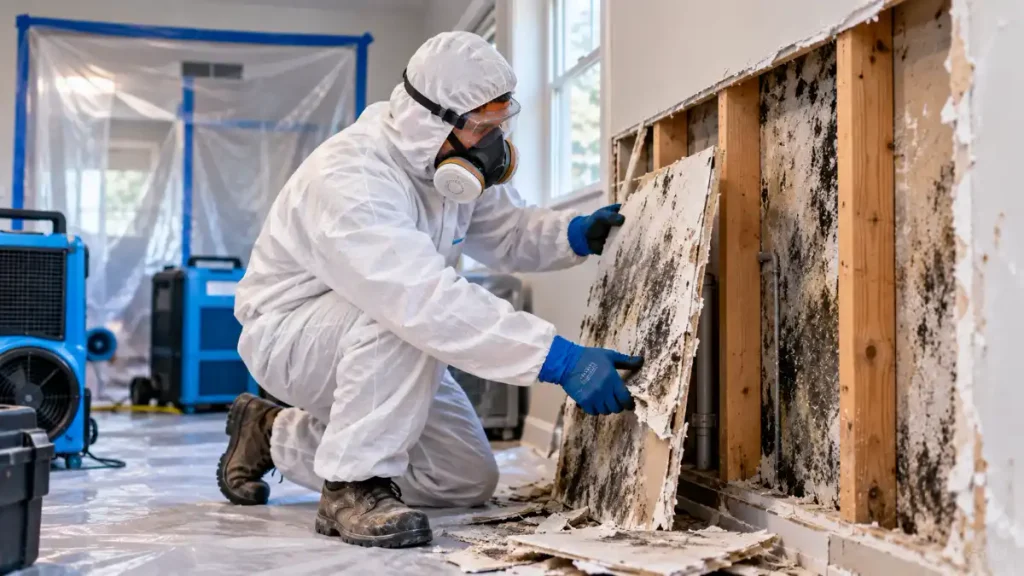
For larger projects, professionals may establish containment and use HEPA-filtered equipment.
The appropriate methods depend on the size and complexity of the work.
Why Containment Matters
Consider a homeowner removing extensively contaminated drywall next to a living room.
Without appropriate protection, demolition debris and dust may enter adjacent spaces.
A properly planned project considers work-area separation, waste handling, equipment, and occupant protection.
Do not assume that household ventilation alone provides adequate contamination control.
Mistake 6: Keeping Materials That Cannot Be Cleaned
Some materials can be cleaned successfully.
Others may be difficult to restore because mold can grow within porous structures.
The correct decision depends on material type, contamination, and the extent of water damage.
Which Materials May Need Replacement?
| Material | Typical consideration |
| Ceramic tile | Often cleanable |
| Glass and metal | Usually suitable for cleaning |
| Drywall | May require removal if substantially contaminated |
| Carpet | May require disposal |
| Carpet padding | Often difficult to restore after extensive contamination |
| Ceiling tiles | May require replacement |
| Structural wood | Requires assessment of condition and cleaning feasibility |
A severely contaminated carpet should not automatically be treated like a ceramic bathroom wall.
Similarly, homeowners should not demolish sound structural components without an appropriate assessment.
The EPA warns that some moldy porous materials may be difficult or impossible to clean completely.
Mistake 7: Ignoring Hidden Moisture
Visible growth may represent only part of the problem.
Water can travel beneath flooring, behind cabinets, and through wall cavities.
A ceiling stain may originate from a roof leak some distance away.
A leaking dishwasher may damage flooring even when the cabinet interior appears relatively unaffected.
How to Investigate More Effectively
Start with the known water source.
Document visible damage.
Check surrounding materials for dampness or deterioration.
If the moisture path is unclear, arrange a professional assessment.
Moisture meters and targeted inspections can help determine whether additional materials require attention.
Avoid unnecessary demolition without understanding potential contamination and other building hazards.
Mistake 8: Paying for Unnecessary Mold Testing
Homeowners sometimes believe that every mold problem requires laboratory analysis before cleanup.
This is not generally true.
When visible growth is present, the immediate need is usually to address contamination and moisture.
The EPA states that visible mold generally does not require sampling and that no federal limits have been established for airborne mold concentrations.
When Can Testing Be Useful?
Testing may support a complex investigation or a specifically designed verification procedure.
However, it should answer a defined question.
Ask the testing provider:
- What is the purpose of sampling?
- How will the results affect the cleanup plan?
- What methods will be used?
- Who will interpret the findings?
- What limitations apply?
An unexplained test result may add expense without clarifying the underlying problem.
Mistake 9: Ignoring Personal Protective Equipment
Mold cleanup can create exposure to particles and other hazards.
Protection should be appropriate for the task.
For suitable small DIY cleanup, the CDC advises at least a NIOSH-approved N95 respirator, protective gloves, and goggles that protect against dust and small particles. More extensive demolition may require a higher level of respiratory protection.
Respirators must fit correctly and be appropriate for the exposure.
Professional projects can require additional training, equipment, and respiratory protection procedures.
Who Should Avoid Cleanup?
People with asthma, COPD, immune suppression, or relevant allergies should not participate in mold cleanup.
These individuals may experience more significant health effects from exposure.
If symptoms occur or health conditions complicate the situation, seek appropriate medical advice.
Do not use ordinary household cleaning recommendations as a substitute for a professional safety assessment.
Mistake 10: Rebuilding Before Materials Are Dry
Removing visibly contaminated drywall does not automatically mean the remaining wall cavity is ready for reconstruction.
Moisture may remain in wood framing, subflooring, or adjacent materials.
Installing new finishes over damp assemblies can conceal unresolved problems.
What Should Happen Before Reconstruction?
The contractor should determine whether affected materials have reached appropriate drying conditions.
For larger projects, moisture readings and drying records may be useful.
The moisture source must also be corrected.
Reconstruction should begin only after the relevant cleanup and drying objectives have been achieved.
Mistake 11: Hiring a Contractor Without Comparing the Work
A low quote may look attractive during an urgent household problem.
However, two estimates may include different services.
One might cover only visible surface cleaning.
Another may include containment, removal, drying, and documentation.
Neither can be evaluated fairly without understanding the actual property conditions.
Compare the Scope, Not Just the Price
| Question | Why it matters |
| What caused the damage? | Identifies the underlying problem |
| Which materials will be removed? | Explains demolition requirements |
| What containment is included? | Clarifies occupant protection |
| How will materials be dried? | Establishes drying expectations |
| Is reconstruction included? | Prevents surprise expenses |
| How will completion be verified? | Defines the expected outcome |
| What happens if more damage is discovered? | Clarifies change-order procedures |
Ask for a written proposal.
Verify the contractor’s relevant experience, references, insurance, and any locally required credentials.
The EPA recommends checking experience and references when hiring remediation professionals.
DIY vs. Professional Mold Remediation
The right decision depends on the conditions rather than a preference for doing the work yourself.
| Decision factor | DIY approach | Professional approach |
| Small, accessible surface patch | May be appropriate | Not always necessary |
| Extensive growth | Generally unsuitable | Professional help advisable |
| Contamination behind walls | Difficult to investigate safely | Specialized assessment may help |
| Sewage-contaminated flooding | Not ordinary DIY cleaning | Specialized professional assistance |
| Complex containment | Usually impractical | Can be incorporated into the work |
| Drying large building assemblies | Limited capability | Professional equipment may be needed |
| Formal documentation | Homeowner records | Project documentation may be available |
Professional services are not automatically better merely because they are expensive.
The appropriate scope, methods, and qualifications determine whether a proposed service is suitable.
Three Examples of Common Mold Problems
Example 1: Bathroom Ceiling Discoloration
A homeowner repeatedly discovers small spots near a shower.
The exhaust fan is not working correctly, and condensation remains on the ceiling.
After evaluating the surface and checking for leaks, the homeowner may be able to clean a limited problem appropriately.
However, repairing ventilation and controlling moisture are essential to prevention.
Example 2: Leaking Washing Machine
A washing-machine hose fails and releases water across a laundry room.
The visible floor dries, but water has traveled beneath the flooring and into an adjacent wall.
A professional moisture assessment may be necessary to determine whether concealed materials need drying or removal.
Cleaning visible discoloration alone would not establish that the damage has been addressed.
Example 3: Basement Flooding
A basement floods after heavy rainfall.
Carpeting, drywall, insulation, and stored possessions become saturated.
The water may contain additional contaminants, and the damage extends beyond a small accessible surface.
Professional assistance is appropriate for evaluating water contamination, removing damaged materials, drying the structure, and planning remediation.
How to Check Whether Cleanup Was Successful
The room should not simply look better.
The moisture problem should be resolved, contaminated materials appropriately cleaned or removed, and remaining materials adequately dried.
For substantial projects, documentation can help establish what was done.
Useful records include photographs, material-removal details, moisture readings where relevant, and verification reports when specified.
A persistent musty odor or recurring visible growth may indicate a need for further investigation.
The objective is not to eliminate every naturally occurring mold spore from a building.
It is to correct unwanted growth and the conditions that support it.
How to Prevent Future Problems
Preventive maintenance should target the moisture source.
Repair leaking plumbing and roofing.
Maintain drainage around the foundation.
Inspect appliance connections and air-conditioning condensate systems.
Improve appropriate ventilation in bathrooms and kitchens.
The EPA recommends keeping indoor humidity below 60%, ideally between 30% and 50% where practical.
A hygrometer can help monitor indoor conditions, but humidity readings cannot identify every concealed leak.
Periodically inspect areas that have experienced previous water damage.
Frequently Asked Questions
Can I clean mold myself?
Certain small, manageable concerns would prove to be good DIY cleanup choices, conducted with a hint of caution. Severe or complex damage may need professional help.
What is the most common remediation mistake?
This is also why cleaning visible growth by itself often results in recurrences unless the moisture source has been corrected.
How to Get Rid of Mold With Bleach
Absolutely not. Physical cleaning, correct materials handling, and moisture control are a must!
Can I paint over mold?
No. Before refinishing, the contamination and moisture problem must be dealt with.
Does an expert require mold screening?
Not necessarily. Contamination cleanup is often indicated by visible growth rather than laboratory sampling.
Can household fans spread contamination?
Inadequate airflow can disseminate the particles, especially when demolishing or otherwise disturbing material where mold spores may be present.
Moldy Drywall: Should All Moldy Drywall Be Removed?
Not automatically. Suitable treatment depends on the degree of contamination, condition, and cleanability.
Is professional remediation always expensive?
Prices vary with the amount of labor required. Resources differ for small surface problems and extensive structural damage.
What if mold keeps returning?
Examine any moisture issues that remain unresolved, identify whether there is hidden water damage or poor ventilation, and discover other conditions that make recurrence possible.
How do I know that the cleanup is completed?
Validate that the source of moisture has been corrected, the contamination has been addressed, drying on remaining materials completed and completion criteria are agreed.