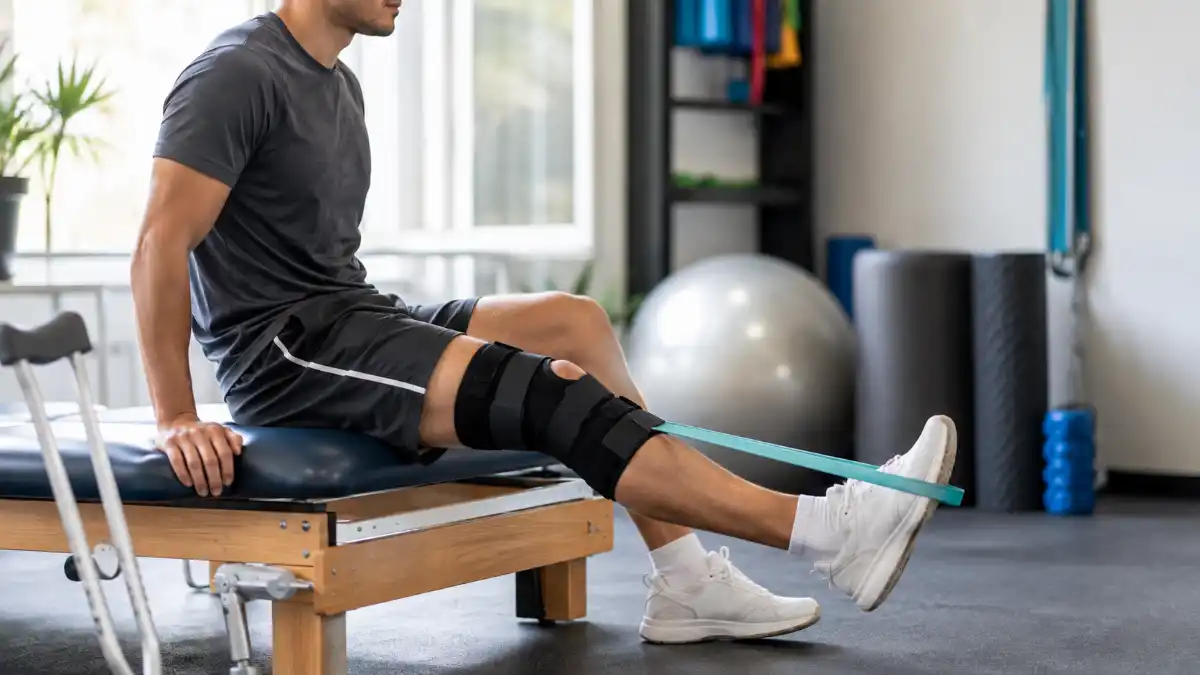
Knee Ligament Injury Recovery Period: How Long It Really Takes to Heal
A knee ligament injury recovery period can range from a few weeks for a mild sprain to 9–12 months or longer after major ligament reconstruction. The timeline depends on which ligament is injured, the severity of the tear, whether other structures such as the meniscus are damaged, the treatment approach, and how well the knee regains strength, stability, and function.
For example, a Grade 1 medial collateral ligament (MCL) injury may heal in about 1–3 weeks, while a complete anterior cruciate ligament (ACL) injury treated with reconstruction commonly requires many months of rehabilitation before an athlete is ready for unrestricted sport.
The knee has four major ligaments:
- Anterior cruciate ligament (ACL)– controls forward movement and rotational stability.
- Posterior cruciate ligament (PCL)– helps control backward movement of the tibia.
- Medial collateral ligament (MCL)– stabilizes the inner side of the knee.
- Lateral collateral ligament (LCL)– stabilizes the outer side of the knee.
Because these ligaments differ in location, function, injury patterns, and response to treatment, there is no single recovery time that applies to every knee ligament injury.
Knee Ligament Injury Recovery Time
Typical recovery or return-to-sport ranges vary by ligament and injury grade:
| Ligament | Grade 1 | Grade 2 | Grade 3 / Surgical |
| MCL | About 1–3 weeks | About 4–6 weeks | About 6 weeks or longer; surgery can take longer |
| LCL | About 3–4 weeks | About 8–12 weeks | About 8–12 weeks non-surgical; surgical cases may require several months |
| PCL | About 4–6 weeks | About 6–8 weeks | About 8–12 weeks non-surgical; surgical cases may require 6–9 months |
| ACL | Often managed according to symptoms and stability | Recovery varies; often several months | Reconstruction commonly requires about 9–12 months before return to sport |
These are general clinical ranges rather than guarantees. Return to sport should depend on recovery of strength, range of motion, stability, movement control, and sport-specific function—not simply the number of weeks since injury.
- Read more: Knee Ligament Injury Recovery Period
What Do the Three Injury Grades Mean?
Doctors commonly describe ligament sprains using three grades.
Grade 1: Mild Sprain
The ligament is stretched and has minor fiber damage, but the knee remains relatively stable. Recovery is usually the fastest, although the exact timeline depends on which ligament is injured.
For example, Grade 1 MCL injuries commonly heal within 1–3 weeks, while Grade 1 LCL injuries may take around 3–4 weeks and Grade 1 PCL injuries may require roughly 4–6 weeks.
Grade 2: Partial Tear
A Grade 2 injury involves more substantial ligament damage and may cause some looseness or instability. Recovery commonly takes several weeks and can extend into a few months depending on the ligament and the patient’s functional progress.
Grade 3: Complete Tear
A Grade 3 injury is a complete ligament tear and generally causes greater instability. Some Grade 3 collateral ligament injuries can be treated without surgery, while severe ACL, PCL, LCL, or combined injuries may require surgical treatment.
The treatment decision depends on the specific injury rather than the grade alone.
MCL Injury Recovery Timeline
The medial collateral ligament (MCL) runs along the inside of the knee and helps control side-to-side movement.
MCL injuries often respond well to non-surgical treatment, particularly when the injury is isolated. Cleveland Clinic reports the following general healing ranges:
- Grade 1: about 1–3 weeks
- Grade 2: about 4–6 weeks
- Grade 3: about 6 weeks or longer
Surgery may be considered in selected cases, particularly when there are additional injuries or the ligament does not heal adequately with conservative treatment.
An important distinction is that healing time is not necessarily the same as return-to-sport time. An athlete may need additional rehabilitation after the ligament has biologically healed to restore strength, movement control, and confidence.
LCL Injury Recovery Timeline
The lateral collateral ligament (LCL) runs along the outside of the knee and helps resist forces that would push the knee outward.
Cleveland Clinic reports approximate recovery ranges of:
- Grade 1: 3–4 weeks
- Grade 2: 8–12 weeks
- Grade 3: 8–12 weeks
More complex Grade 3 injuries can require surgery, particularly when other stabilizing structures are damaged. Clinical guidance for LCL injuries also emphasizes restoring full, painless range of motion and resolving instability before return to sport.
PCL Injury Recovery Timeline
The posterior cruciate ligament (PCL) sits inside the knee and helps prevent excessive backward movement of the tibia.
Milder isolated PCL injuries can often be managed without surgery, using protection and progressive rehabilitation. A clinical review reports approximate non-operative return-to-sport ranges of:
- Grade 1: 4–6 weeks
- Grade 2: 6–8 weeks
- Grade 3: 8–12 weeks
However, these numbers should not be interpreted as automatic clearance for competitive sport. Some rehabilitation protocols continue for several months, with return depending on knee stability and restoration of quadriceps strength and function.
For higher-grade PCL injuries, immobilization may be used during the early phase. StatPearls notes that Grade III PCL injuries can be treated with approximately four weeks of knee immobilization followed by rehabilitation. Surgery is generally reserved for selected cases, including combined ligament injuries, certain bony avulsions, or persistent instability.
ACL Injury Recovery Timeline
The anterior cruciate ligament (ACL) is one of the main stabilizers of the knee and is particularly important for activities involving cutting, pivoting, jumping, and rapid changes of direction.
ACL recovery is often considerably longer than recovery from an uncomplicated collateral ligament sprain.
Partial or Non-Surgical ACL Injuries
Not every ACL injury automatically requires reconstruction.
Some patients with partial or even complete ACL injuries can be managed with rehabilitation when the knee remains functionally stable, and the person’s activity demands are compatible with non-operative treatment. AAOS notes that treatment decisions depend on factors including knee instability, associated injuries, health, and activity level.
For non-operative ACL injuries, recovery can take several months to a year, depending on functional recovery and the individual’s goals.
ACL Reconstruction Recovery
For people who undergo ACL reconstruction, rehabilitation is measured in months rather than weeks.
AAOS states that recovery after ACL reconstruction generally ranges from 6–12 months, while clinical literature commonly places return to sport around 9–12 months, depending on the individual and the demands of the sport.
A simplified rehabilitation progression may look like this:
Early weeks:
The focus is on controlling swelling and pain, restoring knee motion—particularly extension—and beginning appropriate muscle activation.
Weeks 2–6:
Rehabilitation progresses toward normalized walking, improved range of motion, and gradual strengthening as permitted by the surgical protocol.
Weeks 6–12:
Strength, balance, movement control, and functional capacity become increasingly important.
Months 3–6:
Rehabilitation generally becomes more demanding, with progressive strengthening and, when appropriate, low-impact cardiovascular work.
Months 6–9+:
Running, jumping, agility, and sport-specific activities may be introduced progressively when appropriate milestones have been achieved.
Around 9–12 months or longer:
Some athletes may be considered for unrestricted return to competitive sport after meeting objective strength, stability, movement, and functional criteria.
The calendar is only one part of the decision. The knee must demonstrate adequate recovery before high-demand sport is resumed.
Why ACL Recovery Takes So Long
ACL reconstruction is not simply a matter of waiting for an operation wound to heal. Rehabilitation also involves restoring strength, coordination, neuromuscular control, and the function of the reconstructed ligament.
AAOS explains that recovery involves tissue integration and the restoration of balance, strength, and coordination.
This is why someone may be walking normally months before they are ready for sprinting, cutting, jumping, or competitive sport.
Why MCL Injuries Often Heal Without Surgery
The MCL is an extra-articular collateral ligament, and many isolated MCL injuries can heal with non-operative treatment.
The severity of the injury and the presence of other knee damage matter. Grade 1 and many Grade 2 injuries generally respond well to conservative care, while Grade 3 injuries may still heal without surgery but can require longer rehabilitation or additional treatment depending on the injury pattern.
It is therefore more accurate to say that the MCL often has good healing potential rather than assuming that every complete MCL tear will heal in the same timeframe.
What Determines Your Personal Recovery Timeline?
Your actual knee ligament injury recovery period can differ substantially from the typical range.
Important factors include:
- Which ligament is injured
- Grade and exact tear pattern
- Whether the injury is isolated or combined
- Meniscus or cartilage damage
- Whether surgery is required
- Age and general health
- Baseline strength and fitness
- Range of motion
- Knee stability
- Physical therapy adherence
- Job and daily activity demands
- Sport and level of competition
- How the knee responds during rehabilitation
Combined ligament injuries are particularly important because treatment and rehabilitation can be substantially more complicated than an isolated ligament injury. AAOS notes that patients with multiple ligament injuries or associated meniscus or cartilage damage may require surgery.
Healing Time vs. Return-to-Sport Time
One of the most important points to understand is that ligament healing and return to sport are not the same thing.
A ligament can be sufficiently healed for everyday walking while the knee is still not ready for:
- Sprinting
- Jumping
- Cutting
- Pivoting
- Contact sports
- Heavy lifting
- Competitive competition
For example, ACL reconstruction recovery may take 6–12 months, and the return-to-sport decision is based on individual recovery rather than a fixed date.
This distinction is particularly important for athletes because returning too early can expose the recovering knee to forces it is not yet prepared to handle.
Do All Knee Ligament Injuries Need Surgery?
No.
Many MCL and lower-grade LCL injuries are treated without surgery. Isolated PCL injuries can also frequently be managed conservatively. ACL treatment is more individualized: active patients with significant instability or high-demand sporting goals are more likely to undergo reconstruction, while some patients can manage successfully with rehabilitation and activity modification.
Surgery is more likely to be considered when there is:
- Significant or persistent instability
- A combined ligament injury
- Associated meniscus or cartilage damage
- A bony avulsion or other structural injury
- Failure of appropriate conservative treatment
- A need to return to high-demand pivoting activities
The exact decision should be made with an orthopedic or sports-medicine professional.
When Should You See a Doctor?
Seek medical evaluation after a significant knee injury, particularly if you experience:
- Sudden swelling
- A popping sensation during the injury
- Significant pain
- Difficulty bearing weight
- A feeling that the knee is giving way
- Restricted movement
- Locking or catching
A clinical examination can help determine which structures may be injured, while imaging such as magnetic resonance imaging (MRI) may be used when appropriate.
An accurate diagnosis matters because recovery differs substantially between an MCL sprain, ACL tear, PCL injury, LCL injury, meniscus injury, and combined ligament injury.
Frequently Asked Questions
How long does a mild knee ligament sprain take to heal?
It depends on the ligament. A Grade 1 MCL injury may heal in about 1–3 weeks, while Grade 1 LCL and PCL injuries can take longer. Recovery should be guided by symptoms, stability, range of motion, and functional progress rather than a fixed number of days.
Can a torn ACL heal without surgery?
Some ACL injuries can be managed without reconstruction, particularly when the knee remains functionally stable and the person’s activity demands are compatible with non-operative treatment. However, active patients with significant instability or high-demand pivoting sports may be candidates for reconstruction.
Which knee ligament usually heals fastest?
MCL injuries often have relatively favorable healing outcomes, particularly when the injury is isolated. A Grade 1 MCL injury commonly heals in about 1–3 weeks, although the timeline increases with injury severity.
When can I return to sport after ACL reconstruction?
There is no single safe date for everyone. ACL reconstruction recovery commonly takes 6–12 months, and return to competitive sport is often around 9–12 months or longer depending on the athlete’s strength, stability, coordination, rehabilitation progress, and functional testing.
Do all knee ligament injuries need a brace?
No. Bracing depends on the ligament, injury severity, treatment approach, and clinician’s protocol. Some MCL, LCL, and PCL injuries are treated with bracing, while a brace is not automatically required for every ligament injury.
Can I return to sport as soon as the ligament stops hurting?
Not necessarily. Pain relief is only one part of recovery. The knee also needs adequate strength, range of motion, stability, balance, and sport-specific function before high-demand activity is resumed.