


Using per correctly is easy once you understand its main purpose. The word is especially useful when describing prices, rates, frequency, measurements, quantities, and comparisons. It is short, common, and appears in everyday English as well as business, academic, scientific, and technical writing.
For example:
The service costs $10 per month.
Here, “per month” tells the reader that $10 applies to each month.
Another example is:
The car was traveling at 60 miles per hour.
In this sentence, “per hour” shows the rate at which the car was moving.
Although the basic meaning is simple, confusion often occurs with expressions such as per your request, as per, per each, and per se. Some writers also use “per” too often because they think it automatically sounds more professional.
This guide explains how to use per correctly in a sentence, when it sounds natural, when another word may be better, and which common mistakes to avoid.
What Does Per Mean?
In simple English, per most often means:
- for each
- for every
- according to, in some formal uses
The most common use is to express a relationship between one quantity and another.
For example:
Tickets cost $15 per person.
This means:
Tickets cost $15 for each person.
Another example:
The printer can produce 40 pages per minute.
This tells us that the printer produces 40 pages for every minute at the stated rate.
The word is therefore especially useful when discussing:
- cost
- time
- speed
- frequency
- quantity
- measurements
- business performance
- statistics
- productivity
When Should You Use Per?
Use per when one amount, quantity, or value is being compared with another unit.
Common examples include:
- dollars per hour
- miles per gallon
- calls per day
- sales per employee
- calories per serving
- customers per month
- pages per minute
- units per box
- visitors per day
- cost per click
This construction makes rates easier to understand because it tells the reader exactly what unit is being used for comparison.
For example:
The employee earns $25 per hour.
The amount is $25, while the unit is one hour.
Another example:
The website receives 5,000 visitors per day.
The number of visitors is being measured against one day.
- Read more: How to Use Per Correctly in a Sentence
Correct Sentence Structure With Per
A common structure is:
amount + per + unit
Example:
The room costs $150 per night.
Here:
- amount = $150
- per = rate marker
- unit = night
Another common structure is:
quantity + per + period
Example:
She exercises three times per week.
This tells us the frequency of the activity.
You may also see:
number + noun + per + noun
Example:
The factory produces 500 units per shift.
This means 500 units are produced during each shift at the stated rate.
Per in Prices

One of the most common uses of per is with prices.
Examples include:
$50 per ticket
$100 per night
$20 per user
$15 per month
$5 per item
$30 per person
The word identifies exactly what unit the price applies to.
For example:
The hotel charges $120 per night.
This means each night is priced at $120 under the stated pricing arrangement.
Likewise:
The tour costs $40 per person.
This means each person is charged $40.
Using “per” makes the price structure clear and concise.
Per in Measurements
The word is also essential in measurements.
Examples include:
- miles per hour
- kilometers per hour
- meters per second
- liters per minute
- people per square mile
- calories per serving
- grams per portion
- requests per second
For example:
The runner maintained a speed of 10 kilometers per hour.
Here, the distance is measured against time.
Another example:
The system can process 1,000 requests per second.
This compares the number of requests with one second.
These expressions are especially common in science, technology, transportation, engineering, and data analysis.
Per in Frequency
You can use per to express how often something happens.
Examples:
We publish five articles per week.
She attends two meetings per month.
The company performs four inspections per year.
He exercises once per day.
The newsletter is sent twice per month.
In these sentences, “per” shows frequency over a specific period.
It is especially useful when the writer wants to present the information as a rate rather than as a simple routine.
Per vs Each
The words per and each can sometimes communicate a similar idea, but they are not always interchangeable.
Compare:
The tickets cost $10 per person.
and:
The tickets cost $10 each.
Both are natural.
However, consider:
60 miles per hour.
This is a standard unit of speed.
You would not normally replace it with:
60 miles each hour.
That sentence could have a different meaning. It might suggest that someone travels 60 miles during every hour, rather than simply stating a speed.
When to Use Per
Use it when expressing:
- rates
- measurements
- ratios
- prices
- frequency
When to Use Each
Use “each” when referring directly to individual people or items.
Example:
Each ticket costs $10.
The focus is on each ticket individually.
Per vs A or An
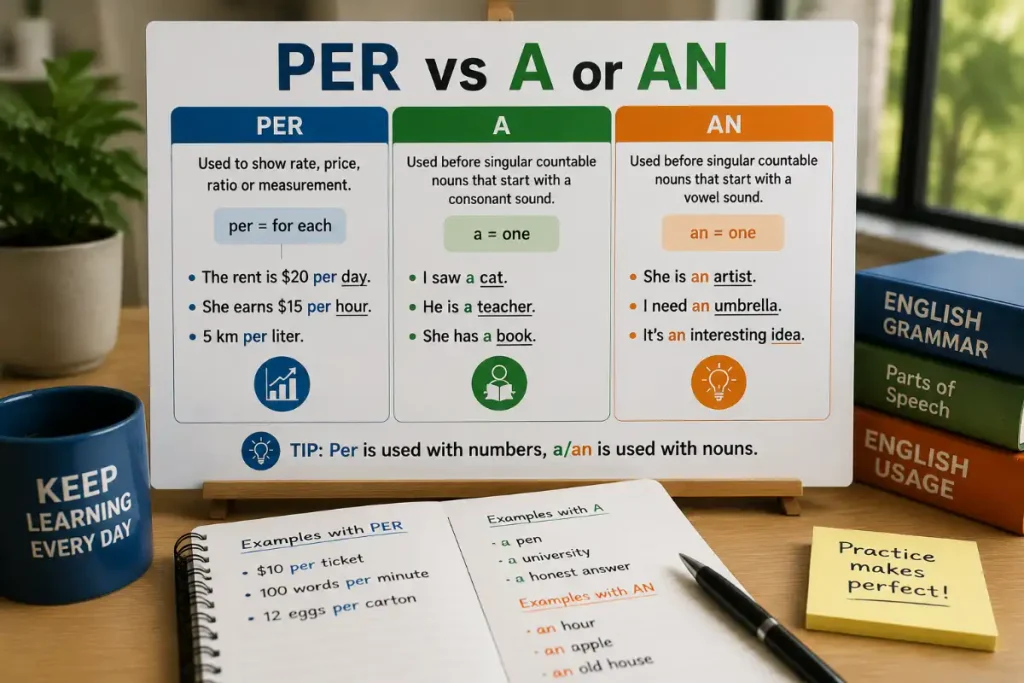
In some everyday expressions, a or an can replace per.
For example:
twice per week
and:
twice a week
Both are correct.
Another example:
$20 per hour
and:
$20 an hour
Both are also natural.
The difference is mostly about style and tone.
“Per” often sounds:
- more precise
- more formal
- more suitable for data or rates
“A” or “an” often sounds:
- more conversational
- more natural in speech
- less formal
For example:
I go to the gym four times a week.
sounds more natural in everyday conversation than:
I go to the gym four times per week.
However, in a report, “per week” may be more appropriate.
Is “Per Your Request” Correct?
Yes.
For example:
Per your request, I’ve attached the document.
This means:
As you requested, I’ve attached the document.
The phrase is common in:
- professional emails
- office communication
- administrative writing
- business correspondence
- formal notices
However, it can sometimes sound unnecessarily stiff.
Instead of:
Per your request, I am providing the information below.
You could write:
Here’s the information you requested.
The second sentence is shorter, more direct, and often more natural.
When “Per Your Request” Works Well
It can be useful when you want a concise, professional tone.
Example:
Per your request, the updated invoice is attached.
This is clear and acceptable in a formal email.
When to Use a Simpler Alternative
For a friendly message, you may prefer:
I’ve attached the invoice you requested.
The meaning is the same, but the tone is warmer.
Is “As Per” Correct?
Yes, as per is an established phrase, but it sounds formal.
Example:
As per company policy, all visitors must register.
A simpler alternative is:
According to company policy, all visitors must register.
Another option is:
Company policy requires all visitors to register.
The best choice depends on the tone of the document.
“As per” is commonly used in:
- official notices
- administrative writing
- business emails
- procedural documents
However, in general writing, it can sound unnecessarily bureaucratic.
Per vs As Per
Compare these three sentences:
Per your instructions, I updated the report.
As per your instructions, I updated the report.
I updated the report as you instructed.
All three are understandable.
The third version is often the most natural.
The first is concise and professional.
The second is more formal and may sound bureaucratic.
Avoid Unnecessary “Per Each”
Consider:
Tickets cost $10 per each person.
This is unnecessarily repetitive.
Better:
Tickets cost $10 per person.
Or:
Tickets cost $10 for each person.
Because per already carries the idea of “for each,” adding “each” is usually unnecessary in simple rate expressions.
Another awkward example is:
Two items are allowed per each customer.
Better:
Two items are allowed per customer.
Avoid Overly Formal Writing
Some writers overuse per because they believe it makes a sentence sound more professional.
Compare:
As per our previous conversation, we have implemented the changes as per your instructions.
with:
As discussed, we’ve made the changes you requested.
The second is easier to read.
Professional writing should be:
- clear
- direct
- concise
- easy to understand
Using formal words does not automatically improve writing.
Per in Business Writing
The word is extremely useful in business metrics.
Common examples include:
- cost per customer
- revenue per employee
- profit per unit
- sales per store
- orders per hour
- conversions per visitor
- revenue per user
- cost per lead
- price per share
- earnings per share
These expressions often allow businesses to compare performance more fairly.
For example:
Store A made $100,000 in revenue.
Store B made $200,000 in revenue.
At first, Store B appears better.
However, if Store A has fewer employees or customers, looking at revenue per employee or revenue per customer may provide a more meaningful comparison.
That is why “per” is so common in business analysis.
Per in Academic Writing
Researchers and analysts also use rate expressions frequently.
Examples include:
incidents per 1,000 people
cases per population group
responses per participant
errors per test
events per year
The exact unit should always be explained clearly so the reader understands what is being measured.
For example:
10 incidents per 1,000 people
is more meaningful than simply writing:
10 incidents
because the first version gives context.
Per in Scientific and Technical Writing
Scientific and technical writing relies heavily on units.
Examples include:
- meters per second
- liters per minute
- grams per liter
- watts per square meter
- revolutions per minute
- data requests per second
The word helps connect measurements in a standardized way.
For example:
The pump moves 20 liters per minute.
The sentence clearly states the flow rate.
Per in Everyday English
Common examples include:
How much does it cost per person?
How many hours do you work per week?
How many times per day should this task be completed?
What’s the price per item?
How many pages can the printer produce per minute?
How much do you pay per month?
These are completely natural English sentences.
You may use “per” every day without noticing it because it appears in so many common expressions.
Per in Travel and Hospitality
Travel-related pricing often uses per.
Examples include:
- per night
- per person
- per room
- per booking
- per day
- per vehicle
For example:
The hotel costs $180 per room per night.
This means the rate applies to each room for each night.
Another example:
The tour costs $60 per person.
This indicates an individual rate.
Per in Work and Salary
You may also see it when discussing pay.
Examples:
- $20 per hour
- $800 per week
- $4,000 per month
- $50,000 per year
For example:
The employee earns $25 per hour.
This tells the reader the hourly rate.
However, actual pay may depend on the number of hours worked and other terms.
Per in Digital Marketing
Digital marketing uses many “per” metrics.
Examples include:
- cost per click
- cost per lead
- cost per acquisition
- revenue per visitor
- conversions per session
- clicks per impression
For example:
The campaign has a cost per click of $2.
This compares advertising cost with the number of clicks.
These metrics help marketers evaluate efficiency.
20 Correct Examples of Per in Sentences
- The service costs $30 per month.
- Admission is $10 per person.
- She exercises five times per week.
- The printer produces 50 pages per minute.
- The vehicle travels at 60 miles per hour.
- Each account allows three users per plan.
- The shop sells hundreds of items per day.
- We schedule one meeting per department.
- The dashboard shows revenue per customer.
- The product contains a stated amount per serving.
- The employee earns $25 per hour.
- Per the instructions, complete the form online.
- Per your request, I updated the document.
- Only one coupon is allowed per order.
- The factory tracks defects per batch.
- The subscription costs $12 per user per month.
- The machine produces 600 units per shift.
- The newsletter is published twice per month.
- The tour price is calculated per person.
- The website receives thousands of visitors per day.
Common Errors to Avoid
Error 1: Using “Per Each”
Avoid:
$5 per item.
Better:
$5 per item.
Or:
$5 for each item.
Error 2: Using Per Only to Sound Formal
Avoid unnecessarily stiff language.
Instead of:
Per our previous correspondence…
you may simply write:
As discussed…
Error 3: Mixing Units
If you write a rate per month, make sure the figures actually relate to a monthly period.
For example, do not write:
100 sales per month
if the figure actually represents weekly sales.
Error 4: Confusing Per With Percent
“Per” and “percent” are different.
For example:
20 miles per hour
is a rate.
20 percent
is a percentage.
Error 5: Confusing Per With Per Se
Per se is a separate expression.
Example:
The price is not the problem per se.
It means the price itself is not the problem.
Error 6: Using Per Without a Clear Unit
A rate should tell the reader what the quantity is measured against.
For example:
100 sales per…
is incomplete.
You need a unit:
100 sales per day.
How to Decide Whether Per Is the Best Choice

Ask yourself these questions:
- Am I describing a rate?
- Am I comparing one quantity with another unit?
- Am I expressing frequency?
- Am I describing price or cost?
- Would “a,” “each,” or “according to” sound more natural?
If the sentence is a clear rate, “per” is often the best choice.
If the sentence is simply formal business language, another phrase may sound better.
Frequently Asked Questions
How do you use per in a sentence?
Use it to connect an amount or quantity with a unit.
Example:
The ticket costs $20 per person.
Can per mean each?
Yes, particularly in rates and prices.
For example:
$10 per ticket
means:
$10 for each ticket.
Is “per your request” correct?
Yes. It means “as you requested.”
Is “as per” grammatically correct?
Yes, although simpler alternatives such as “according to” or “as requested” may sound more natural.
Can I say per day?
Yes.
Example:
The service allows five uses per day.
Can I say per month?
Yes.
Example:
The subscription costs $15 per month.
Is “per each” correct?
It may appear in some special constructions, but in ordinary rates it is usually unnecessarily repetitive.
What is the difference between per and each?
“Per” usually establishes a rate or relationship, while “each” refers directly to individual items or people.
Is per formal?
Not when used in standard rate expressions such as “per hour” or “per person.” However, phrases such as “per your request” can sound formal.
What is the difference between per and as per?
“Per” can mean “according to” in formal writing, while “as per” is a longer and often more formal version of the same idea.
Can per be used with time?
Yes.
Common examples include:
per hour
per day
per week
per month
per year
Is “per person” correct?
Yes. It is a standard expression meaning “for each person.”
Can per be used in business writing?
Yes. It is especially common in metrics such as cost per customer, sales per employee, and revenue per user.
Is per used in scientific writing?
Yes. It is common in measurement units such as meters per second and liters per minute.
Should I avoid using per?
No. Use it whenever it clearly expresses a rate, price, measurement, frequency, or allocation.