

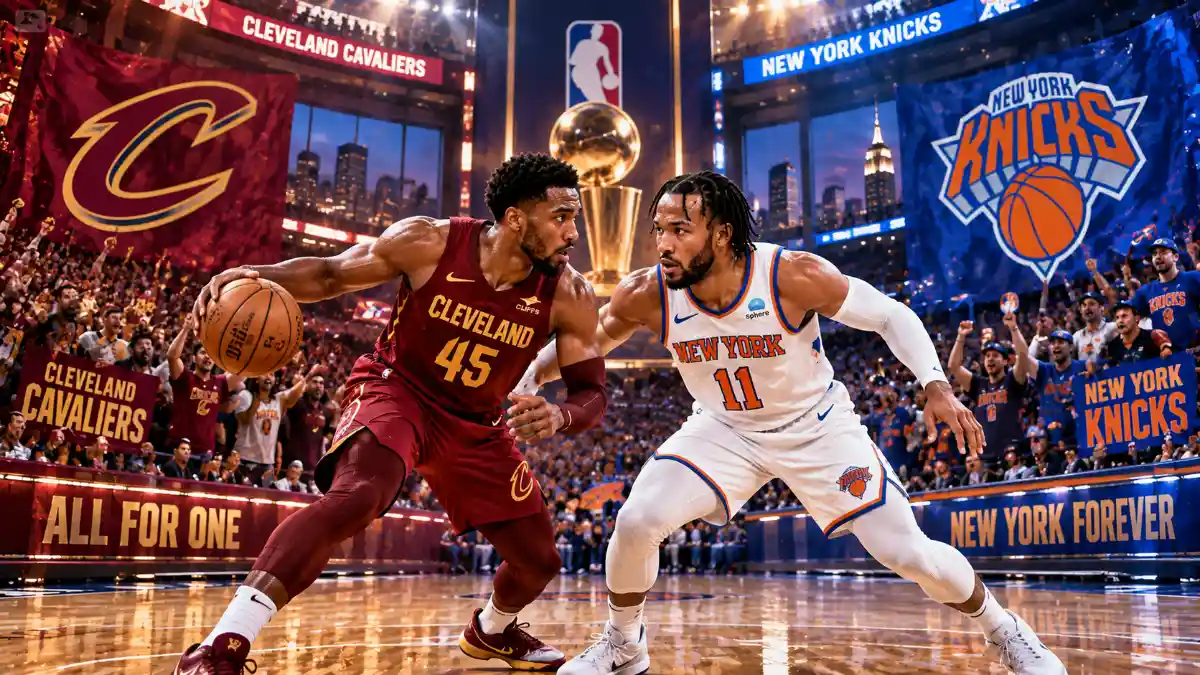
Cavaliers vs Knicks Rivalry: History, Playoffs and Key Matchups
Some NBA rivalries are built through decades of championship battles. Others become meaningful when two competitive teams meet in high-stakes games.
The modern Cavaliers vs Knicks rivalry reflects the second category.
Cleveland and New York have a long regular-season history, but their matchup gained greater attention after the 2023 NBA playoffs, when the Knicks eliminated the Cavaliers in five games.
That postseason encounter gave the rivalry a new dimension, highlighting differences in rebounding, defensive execution, and playoff performance.
Understanding the Cavaliers vs Knicks matchup requires looking beyond final scores. Team strategies, individual performances, historical results, and postseason encounters all help explain how this Eastern Conference rivalry has developed.
Is Cavaliers-Knicks Really a Rivalry?
Cavaliers vs Knicks: That depends on how narrowly you define “rivalry.”
It does not have the uninterrupted historical animosity of some famous NBA pairings. But repeated postseason elimination can accelerate competitive tension quickly.
According to Cleveland’s 2026 postseason guide, the teams had met in four playoff series before the 2026 conference finals—1978, 1995, 1996 and 2023—and New York won all four.
The 2026 Eastern Conference Finals added another major postseason chapter.
That creates a clear asymmetry: Cleveland has significant motivation to rewrite the playoff story, while New York has reason to believe its style translates effectively against the Cavaliers.
That is fertile ground for a modern rivalry.
The 2023 Series Changed the Perception of the Matchup
The 2023 first-round meeting matters because playoff basketball tests teams differently from the regular season.
Opponents can repeatedly target the same weakness. Rotations shorten. Half-court possessions become more valuable. Physicality increases, and every adjustment receives an adjustment of its own.
New York’s victory established a postseason reference point that followed the teams beyond that particular season.
For Cleveland, future success against the Knicks would therefore be judged not just by whether it could win individual regular-season games but whether its style could survive repeated postseason pressure.
That question became even bigger in 2026.
- Read more: New York Knicks
2026 Turned a Matchup Into an Eastern Conference Story
The teams reached the 2026 Eastern Conference Finals by very different routes.
Cleveland needed seven games to eliminate Detroit in the conference semifinals. New York swept Philadelphia 4–0.
Then the Knicks swept Cleveland.
The scores were:
| Game | Result |
| Game 1 | Knicks 115, Cavaliers 104 (OT) |
| Game 2 | Knicks 109, Cavaliers 93 |
| Game 3 | Knicks 121, Cavaliers 108 |
| Game 4 | Knicks 130, Cavaliers 93 |
The pattern is as important as the 4–0 result.
Game 1 reached overtime. By Game 4, New York won by 37.
That suggests a series in which the competitive separation increased rather than decreased.
New York subsequently defeated San Antonio 4–1 in the NBA Finals and won its first championship since 1973.
Cleveland therefore was not eliminated by a team that immediately collapsed in the next round. It was eliminated by the eventual champion.
That context matters when assessing what the Cavaliers need to change.
Why Playoff Matchups Expose More Than Regular-Season Results
The 2025–26 regular season demonstrates why one should be cautious about extrapolating too much from isolated games.
New York won the season series 2–1. The scores were 119–111 and 126–124 in the Knicks’ victories, followed by Cleveland’s 109–94 win in February.
That does not resemble an opponent Cleveland could never beat.
Yet the postseason produced a sweep.
The difference illustrates a fundamental NBA concept: repeatability.
A tactic that works once in January may depend on shooting variance, availability, or an opponent’s schedule. In a playoff series, teams have to produce solutions repeatedly while the other side actively studies how to remove them.
Cavaliers vs Knicks. The better postseason question is not “Can this work?”
It is:
Can this continue working after the opponent knows exactly what is coming?
The Brunson Problem
Any Cleveland plan begins with Jalen Brunson.
A high-level primary creator affects a defense even when he is not shooting. His ability to threaten from multiple areas can force defenders to make choices before the possession reaches its conclusion.
Aggressive help can open passing lanes.
Switching can create a preferred matchup.
Dropping too far can create space.
Defending too high can expose the area behind the initial defender.
The goal for Cleveland is therefore unlikely to be “stop Brunson” in an absolute sense. Elite scorers rarely disappear simply because a defense wants them to.
A more realistic objective is to make his possessions less efficient and less predictable while keeping the rest of the defense structurally sound.
Cleveland’s Mitchell Equation
The same logic applies in the other direction with Donovan Mitchell.
Mitchell gives Cleveland a creator capable of producing offense when conventional actions fail.
That skill is invaluable in postseason basketball.
But there is a difference between using difficult shot-making as an emergency option and requiring it to carry the offense possession after possession.
New York’s ideal defensive outcome is to turn Cleveland into a team dependent on isolated creation.
Cleveland’s ideal outcome is the opposite: use Mitchell’s scoring threat to create advantages that spread through the entire offense.
That means the important statistics go beyond his point total.
Watch his:
- efficiency,
- assists created from defensive attention,
- turnovers,
- paint touches,
- quality of late-clock attempts.
Thirty points can represent a dominant performance or an exhausting night of difficult attempts. Context determines which.
The Frontcourt Chess Match
The modern matchup also has a fascinating frontcourt dimension.
Evan Mobley offers Cleveland defensive range and size. Karl-Anthony Towns gives New York a big who can alter conventional defensive geometry because of his offensive skill set.
When a big can operate away from the basket, traditional rim protection becomes more complicated.
Should the defender follow?
Who protects the paint?
How aggressively should Cleveland switch?
What happens on the defensive glass when the big is pulled away from rebounding position?
These decisions create secondary consequences.
The winner of a possession is often determined not by the first action but by the rotation that follows it.
Why OG Anunoby and Mikal Bridges Matter
Star-focused coverage can make basketball appear like a sequence of one-on-one duels.
It is not.
Players who defend multiple positions, cut without the ball, space the floor, and attack compromised defenses can determine whether a system works.
New York’s championship core included OG Anunoby and Mikal Bridges alongside Brunson, Towns, and Josh Hart.
For Cleveland, that means solving Brunson cannot come at the cost of repeatedly creating easy opportunities for the players around him.
This is one of the biggest reasons playoff defense is difficult.
The first defensive decision creates a second decision. The second creates a third.
Great offenses keep forcing choices until the defense makes the wrong one.
Rebounding Is a Tactical Issue, Not Just an Effort Statistic
“Rebound harder” is not a useful tactical explanation.
Rebounding is affected by positioning, matchups, floor spacing, defensive rotations,s and where players are standing when a shot goes up.
Consider two games from 2025–26.
When New York beat Cleveland 119–111 in October, the Knicks outrebounded the Cavaliers 48–32.
When Cleveland beat New York 109–94 in February, the Cavaliers held a narrow 45–44 advantage.
That does not establish a simple causal rule that “winning rebounds equals winning the game.” Basketball contains too many interacting variables for that.
It does show why Cleveland cannot afford to give New York a large possession advantage.
Every offensive rebound can force the defense to survive another sequence.
Against a strong offense, repeatedly asking the defense to make two stops during one possession is dangerous.
The Hidden Battle: Who Controls Shot Quality?
Fans naturally track field-goal percentage.
Shot quality asks a more useful question: what kind of attempts created that percentage?
A defense can execute well and watch an opponent hit contested jumpers. It can also allow repeated open shots that happen to miss.
Over a long series, the process matters.
For Cleveland, high-quality offense might mean creating:
- paint pressure,
- kick-out threes,
- quick decisions after help,
- favorable switches,
- transition opportunities.
For New York, success may involve:
- putting primary creators into advantageous actions,
- forcing Cleveland’s defense to rotate,
- attacking mismatches,
- earning second possessions,
- converting defensive stops into early offense.
Evaluating these processes gives a clearer picture than simply reading the box score.
Why Game 1 of the 2026 Conference Finals Still Matters
A sweep can flatten our memory of a series.
Game 1 was not a blowout. New York won 115–104 in overtime.
That matters because close games reveal different problems than blowouts.
A competitive game can turn on late execution, possession management, shot selection, or a handful of defensive mistakes.
Once New York escaped with the opener, the series environment changed.
Cleveland faced greater pressure in Game 2. New York could play with the confidence of already having taken a road game.
The subsequent results moved increasingly in New York’s direction.
For future meetings, Cleveland should care about preventing that type of sequence: competitive stretches cannot repeatedly end with New York controlling the decisive possessions.
Why Game 4 Matters for a Different Reason
Game 4 ended 130–93.
A 37-point elimination-game loss is fundamentally different from losing a close opener.
It raises broader questions about whether one team had found repeatable advantages the other could no longer answer.
That does not mean the same margin will persist in 2026–27. Rosters evolve, schemes change, and regular-season conditions differ.
But it gives Cleveland a clear film-study starting point.
What possessions repeatedly failed?
Where did New York create its easiest opportunities?
Which defensive coverages produced poor outcomes?
Where did Cleveland’s offense become predictable?
Those questions turn an embarrassing result into actionable information.
The 2026–27 Schedule Gives Cleveland Immediate Tests
Fans will not have to wait until spring to see how the matchup evolves.
The teams have four scheduled regular-season meetings:
- Nov. 7 in Cleveland
- Nov. 11 in New York
- Nov. 25 in New York
- Dec. 21 in Cleveland
The Nov. 25 contest is part of NBA Cup group play, while the Dec. 21 game has been promoted as an Eastern Conference Finals rematch.
Three meetings occur within 19 days in November.
That concentration is particularly interesting because teams will have recent film and little time to forget what worked in the previous game.
It creates something closer to a miniature adjustment cycle than four games scattered evenly across six months.
How to Evaluate Cleveland’s Adjustments
Do not judge progress solely by wins and losses.
Look for repeatable improvements.
Can Cleveland finish defensive possessions?
If the initial defense works but New York repeatedly recovers the miss, the solution is incomplete.
Can the Cavaliers create offense without excessive isolation?
Mitchell’s individual creation should enhance the system rather than replace it.
Can Cleveland attack New York’s defensive versatility?
Good defenses want offenses to become predictable. Cleveland needs counters when its preferred actions are removed.
Can it handle close-game possessions?
The best postseason opponents make late-game execution essential.
Can Cleveland prevent runs from becoming avalanches?
Game 4 of the conference finals illustrates the danger of losing control completely.
Those indicators provide a better forecast for a potential future playoff meeting than a single November score.
How to Evaluate New York
The Knicks also have something to prove.
Winning a championship changes how opponents prepare for you.
Teams spend an offseason studying successful systems. Opponents experiment with new coverages. Every contender wants evidence that it can beat the defending champion.
New York therefore must demonstrate adaptability.
The question is not whether the Knicks can reproduce every possession from 2025–26. They cannot and should not try.
The question is whether the underlying strengths remain effective after opponents arrive with new answers.
Does Regular-Season Success Predict a Playoff Series?
Only partially.
Regular-season meetings provide useful evidence about matchups, but postseason conditions are different enough that predictions should remain cautious.
Availability can change.
Rotations can shorten.
Coaches can target specific matchups more aggressively.
Players may carry different workloads.
A four-game regular-season series is therefore evidence, not destiny.
Cleveland’s February 2026 victory over New York is a perfect reminder: the Cavaliers demonstrated they could beat the Knicks in a regular-season game, yet New York swept the later conference final.
What Would Make the Rivalry Bigger?
The answer is simple: competitive postseason resistance.
New York currently owns the stronger recent playoff narrative.
For the rivalry to become truly balanced, Cleveland needs its own defining postseason chapter.
That could mean eliminating New York, winning a dramatic series, or even forcing a long, memorable playoff battle that changes how the teams view each other.
Rivalries become powerful when both sides have painful memories.
At the moment, recent postseason pain sits disproportionately on Cleveland’s side.
Why the 2026–27 Meetings Are Worth Watching
The upcoming games answer questions that box scores from last season cannot.
Has Cleveland developed better solutions?
Can New York still dictate the matchup?
How will each side respond after seeing the opponent repeatedly in November?
Will the defending champions continue to control the possession battle?
Could Cleveland’s defensive versatility produce a different result?
Those are basketball questions rather than revenge-story clichés, and they make the matchup worth following.
Conclusion
The modern Cavaliers vs. Knicks story is compelling because the teams have moved beyond ordinary regular-season familiarity.
New York eliminated Cleveland in previous postseason meetings and delivered the biggest recent blow with a 4–0 sweep in the 2026 Eastern Conference Finals. The Knicks then validated that run by winning the NBA championship.
That places the burden of adjustment on Cleveland.
The Cavaliers do not need to “erase” the past—regular-season games cannot do that. They need to demonstrate that the basketball problems exposed by New York now have better solutions.
For the Knicks, the challenge is maintaining the advantages that made them champions while opponents adapt.
If these teams meet again when the stakes are highest, that is where the next true chapter of the rivalry will be written.
Frequently Asked Questions
Have the Cavaliers and Knicks met in the NBA playoffs?
Yes. Cleveland’s 2026 postseason guide records playoff series in 1978, 1995, 1996, and 2023 before their 2026 Eastern Conference Finals meeting.
Who won the 2026 Cavaliers-Knicks playoff series?
New York swept Cleveland 4–0 in the Eastern Conference Finals.
What was the biggest win of the 2026 conference finals?
Game 4 produced the widest margin, with New York winning 130–93.
Did Cleveland beat New York during the 2025–26 regular season?
Yes. Cleveland won 109–94 on Feb. 24, 2026.
Who won the 2025–26 season series?
New York won two of the three regular-season meetings.
Why is Jalen Brunson important to this matchup?
His primary shot creation forces Cleveland to make difficult decisions about individual coverage, switching, and defensive help.
Why is Donovan Mitchell important for Cleveland?
Mitchell provides the Cavaliers with high-level perimeter creation and can generate offense when normal actions are disrupted.
Why does rebounding matter so much?
Second-chance possessions force a defense to make repeated stops and can prevent it from getting into transition offense.
Are Cleveland and New York scheduled to play in the 2026 NBA Cup?
Their Nov. 25 meeting is listed as an NBA Cup East Group B game.
Could the Cavaliers and Knicks meet in the 2027 playoffs?
Yes, if both qualify and the Eastern Conference bracket places them on the same path. Any specific postseason rematch remains hypothetical until the bracket is determined.