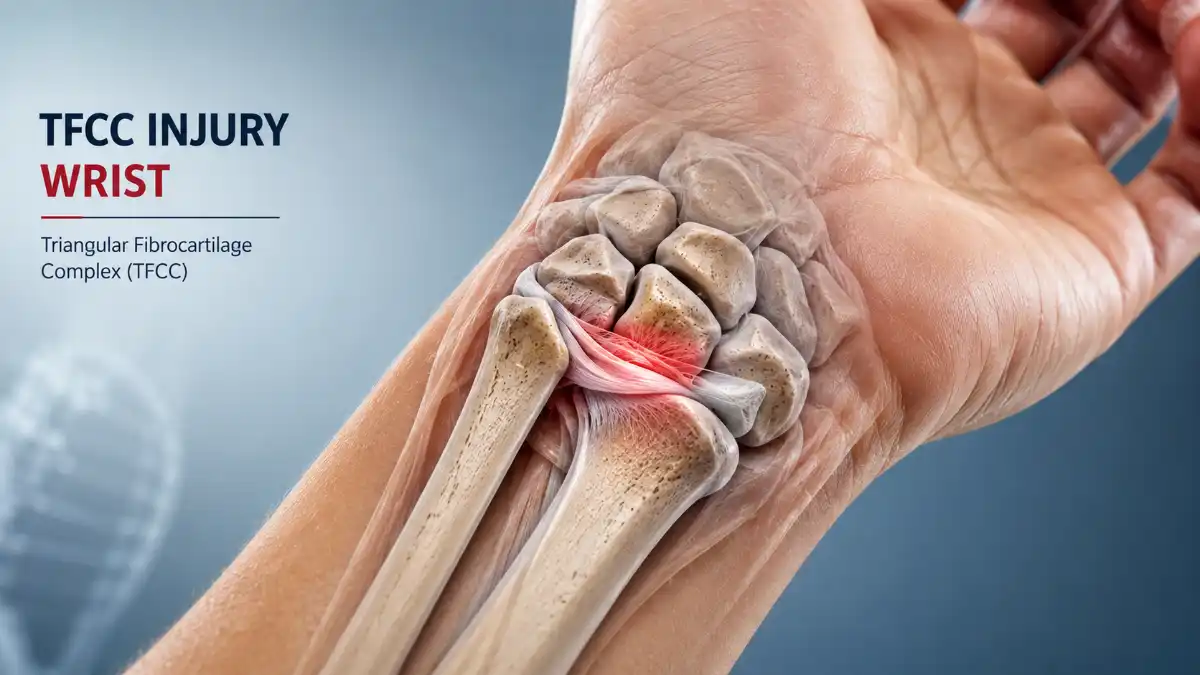
TFCC Injury Wrist: Symptoms, Causes, Treatment, Recovery & Diagnosis
TFCC Injury Wrist: Pain on the little-finger side of your wrist can occur after a fall, sudden twisting movement, repetitive use, or gradual tissue changes. One possible cause is a triangular fibrocartilage complex (TFCC) injury.
The TFCC is a group of cartilage and connective tissues that helps stabilize the wrist and supports forearm rotation and gripping. A TFCC injury can cause ulnar-sided wrist pain, clicking, weakness, and difficulty with certain movements.
However, these symptoms can also occur with other wrist conditions. Symptoms alone cannot confirm a TFCC tear, so persistent or significant wrist pain should be evaluated by a qualified healthcare professional.
What Is a TFCC Injury?
The triangular fibrocartilage complex (TFCC) is located on the ulnar side of the wrist, close to the little finger.
It helps:
- Stabilize the wrist
- Cushion the wrist joint
- Support forearm rotation
- Connect and stabilize structures around the radius and ulna
- Support gripping and wrist movement
A TFCC injury can involve damage to one or more parts of this complex. Some injuries happen suddenly, while others develop gradually as the tissues become more vulnerable over time.
What Are the Symptoms of a TFCC Injury?
Common TFCC injury wrist symptoms include:
- Pain on the little-finger side of the wrist
- Pain during forearm rotation
- Clicking or popping
- Reduced grip strength
- Wrist weakness
- Tenderness
- Limited wrist movement
- Pain when gripping or lifting
- Discomfort when putting pressure on the hand
Symptoms can vary depending on the type and severity of the injury.
- Read more: TFCC Injury Wrist
Where Does a TFCC Injury Hurt?
TFCC-related pain is typically felt on the ulnar side of the wrist, which is the side closest to the little finger.
You may notice pain when:
- Turning a key
- Opening a jar
- Using a screwdriver
- Lifting an object
- Turning your palm upward or downward
- Gripping something tightly
- Putting pressure through your hand
The location of pain can provide a clue, but it cannot establish a diagnosis by itself.
What Does a TFCC Tear Feel Like?
A TFCC tear may feel like a dull ache or sharper pain around the little-finger side of the wrist.
Some people also experience:
Pain With Rotation
Turning the forearm so the palm faces upward or downward may increase discomfort.
Clicking or Popping
Clicking or popping can occur with some TFCC injuries. However, clicking by itself does not prove that a TFCC tear exists.
Weak Grip
Pain, weakness, or wrist instability can make gripping objects uncomfortable or reduce how much force you can comfortably apply.
Reduced Movement
Pain may cause you to avoid certain wrist movements, making the joint feel stiff or restricted.
What Causes a TFCC Injury?
TFCC injuries generally fall into traumatic and degenerative patterns.
Traumatic TFCC Injury
A sudden force can damage the TFCC. Potential causes include:
- Falling onto an outstretched hand
- Sudden twisting of the wrist
- Forceful forearm rotation
- Sports injuries
- Wrist fractures or other significant trauma
Degenerative TFCC Injury
The TFCC can become thinner and more vulnerable with age. Repetitive movements involving gripping, twisting, or forearm rotation may also contribute to gradual tissue damage.
TFCC Injury vs. Other Causes of Wrist Pain
Not every case of ulnar-sided wrist pain is caused by a TFCC injury.
Other possible causes include:
| Condition | Possible features |
| TFCC injury | Ulnar-sided pain, clicking, weakness |
| Wrist sprain | Pain following ligament injury |
| Fracture | Pain after trauma, sometimes with swelling |
| Tendon problem | Pain associated with specific movements |
| Nerve-related problem | Pain, numbness or tingling |
Because several conditions can produce similar symptoms, a healthcare professional may need to combine your history, physical examination, and imaging before determining the cause.
How Is a TFCC Injury Diagnosed?
Diagnosis usually begins with a medical history and physical examination.
A healthcare professional may ask:
- How did the pain begin?
- Was there a fall or twisting injury?
- Which movements cause pain?
- Is there clicking or popping?
- Has your grip become weaker?
- How long have symptoms been present?
The wrist may also be examined for:
- Range of motion
- Tenderness
- Grip strength
- Stability
- Pain during specific movements
Can an MRI Detect a TFCC Tear?
MRI can provide information about soft tissues such as the TFCC. X-rays may also be used to evaluate bones and identify associated problems.
An imaging abnormality does not automatically prove that it is the cause of someone’s symptoms. Healthcare professionals generally interpret imaging together with the person’s symptoms and physical examination.
TFCC Injury Treatment
Treatment depends on the type and severity of the injury, the symptoms, wrist stability, and how the injury affects daily activities.
Activity Modification
Reducing activities that clearly increase pain may help prevent additional irritation.
This can include temporarily limiting:
- Heavy gripping
- Forceful twisting
- Repetitive wrist rotation
- Heavy lifting
- Activities that put substantial pressure on the wrist
Wrist Brace or Splint
A healthcare professional may recommend a wrist or forearm brace or splint to restrict movements while the injury is being managed.
Medication
A healthcare professional may recommend medication for pain or inflammation when appropriate. NSAIDs are not suitable for everyone, so medication choices should be discussed with a doctor or pharmacist.
Physical Therapy
Physical therapy may become part of rehabilitation. Depending on the injury and stage of recovery, treatment may focus on:
- Wrist mobility
- Forearm rotation
- Grip strength
- Wrist stability
- Gradual return to normal activities
Injections
In some cases, a clinician may consider an injection for symptom management. Whether this is appropriate depends on the individual injury and clinical assessment.
Can a TFCC Tear Heal Without Surgery?
Yes, some TFCC injuries can improve without surgery.
Minor or symptomatic injuries may be managed with approaches such as activity modification, bracing, and physical therapy. More persistent or severe injuries may require additional treatment, including surgery.
Whether a particular TFCC tear can heal without surgery depends on factors such as the type of injury, severity, symptoms, and response to conservative treatment.
Does a TFCC Tear Require Surgery?
Not always.
Surgery may be considered when:
- Symptoms continue despite conservative treatment
- The wrist remains unstable
- The injury is severe
- The specific tear requires surgical management
- Pain or functional limitations remain significant
A hand, wrist, or orthopedic specialist can determine whether surgery is appropriate after evaluating the injury.
TFCC Injury Recovery Time
There is no single recovery time that applies to every TFCC injury.
Recovery can depend on:
- Type of injury
- Severity
- Traumatic versus degenerative cause
- Treatment approach
- Wrist stability
- Rehabilitation progress
- Whether surgery is required
Some minor injuries may improve with conservative treatment, while more significant injuries can require a longer period of rehabilitation.
Avoid assuming that every TFCC tear will heal within a specific number of weeks.
TFCC Injury Exercises
Exercises can be useful during rehabilitation, but the correct exercises depend on the injury and stage of recovery.
A rehabilitation program may eventually include:
- Gentle wrist mobility
- Forearm rotation exercises
- Grip strengthening
- Wrist strengthening
- Functional movements
- Gradual return-to-activity exercises
Do not use significant pain as a reason to push harder through an injury. A physical therapist or other qualified healthcare professional can help determine when strengthening and specific exercises are appropriate.
Can You Work Out With a TFCC Injury?
You may need to modify your workouts while recovering.
Exercises involving:
- Heavy gripping
- Loaded wrist extension
- Forceful wrist rotation
- Heavy lifting
- Movements that reproduce pain
may need to be reduced or temporarily avoided.
Athletes and weightlifters should consider professional guidance when deciding which exercises are appropriate and when to increase training load.
When Should You See a Doctor?
Consider having your wrist evaluated if you have:
- Persistent little-finger-side wrist pain
- Difficulty rotating your wrist or forearm
- Significant grip weakness
- Repeated painful clicking or popping
- Swelling
- Reduced wrist movement
- Pain that interferes with work, exercise, or daily activities
- Symptoms that are getting worse
After a major trauma, severe pain, obvious deformity, or major loss of hand function warrants prompt medical attention.
Can You Prevent a TFCC Injury?
You cannot prevent every wrist injury, but some habits may reduce risk.
Consider:
- Warming up before sports
- Increasing training loads gradually
- Using an appropriate technique
- Strengthening the wrist and forearm appropriately
- Avoiding sudden excessive wrist loading
- Taking breaks during repetitive activities
- Addressing persistent wrist pain rather than repeatedly training through it
Frequently Asked Questions
What are the most common TFCC injury wrist symptoms?
Common symptoms include little-finger-side wrist pain, clicking or popping, weakness, reduced grip strength, and discomfort during forearm rotation.
How do I know if my wrist pain is a TFCC injury?
The location and pattern of your symptoms may suggest a TFCC problem, but symptoms alone cannot confirm the diagnosis. A healthcare professional can examine the wrist and determine whether further testing is appropriate.
What does a TFCC tear feel like?
It may feel like an ache or sharper pain on the little-finger side of the wrist, especially during gripping or forearm rotation. Clicking and weakness may also occur.
Where does a TFCC tear hurt?
Pain is commonly felt on the ulnar side of the wrist, near the little finger.
Can a TFCC injury cause grip weakness?
Yes. Pain, weakness, or instability can make gripping uncomfortable or reduce the amount of force you can comfortably apply.
Can a TFCC injury cause clicking?
It can. Painful clicking or popping may occur with some TFCC injuries, although clicking can have other causes.
Can a TFCC tear heal without surgery?
Some TFCC injuries can improve with conservative management such as activity modification, bracing, and rehabilitation. More severe or persistent injuries may require surgery.
How long does a TFCC injury take to heal?
Recovery varies according to the type and severity of the injury and the treatment used. There is no single recovery period that applies to every TFCC injury.
Can I exercise with a TFCC injury?
You may be able to remain active with appropriate modifications, but exercises that increase or reproduce wrist pain may need to be avoided. A qualified professional can help determine an appropriate rehabilitation plan.
Is a TFCC tear serious?
A TFCC injury can range from a relatively minor problem to an injury causing significant pain, weakness, or instability. The seriousness depends on the specific injury and its effect on wrist function.