


A corny, stupid, or hopelessly sentimental person. This is also a term that may be applied to humour, performing, or acting that one finds cliched or too sweet by half.
In American English, it has both grating and surprisingly affectionate connotations. It usually shows up when some friend pokes fun at another who has posted about a minor romantic gesture, and gets spit out of the other as an insult for trying what was clearly just a joke too on-the-nose-logical to be funny.
Understanding the definition is straightforward. It is a mini database of what an actual person looks like. So this is how we use the word organically and helps us understand where it originated from and how it works.
What Does Cornball Mean?
The term has two common grammatical uses: a noun that identifies a person and an adjective that describes someone or something. Both can suggest excessive sentimentality, old-fashioned humor, or a perceived lack of sophistication.
Simple definition
Simply put, it refers to a person or thing that appears very sentimental, cliched and naively simple.
Picture someone making an elaborate romantic speech with overused lines. A listener might feel as though the speech is hyperbolic or outdated and thus describe it this way.
No,o that doesn’t mean it was terms the listener didn’t like and hate one. Nobody expects others to take something seriously while enjoying it and being aware that it’s sentimental or clichéd.
- Read more: Cornball Meaning.
Cornball as a noun
As a noun, it identifies a person.
Example: “He’s a cornball, but he makes everyone laugh.”
The first part describes someone’s personality or humor as unsophisticated. The second part makes the speaker’s appreciation clear.
The noun also works in self-description:
“I’m a cornball when it comes to romantic movies.”
Here, the speaker recognizes their sentimental preferences without necessarily feeling embarrassed about them.
Cornball as an adjective
As an adjective, the word describes a characteristic of a person, joke, movie, performance, or other subject.
Example: “That was a corny joke.”
The speaker considers the joke predictable, old-fashioned, or lacking sophistication.
The grammatical difference is simple: the noun identifies a person, while the adjective describes a quality.
Quick definition
Cornball
Noun: A person regarded as unsophisticated, old-fashioned, or excessively sentimental.
Adjective: Describes someone or something with those qualities.
Example: “That was a cornball performance.”
Tone: Often mildly critical, but sometimes affectionate.
What Does Cornball Mean in Slang?
In informal conversation, the expression often describes someone whose humor, personality, or behavior seems excessively sentimental, predictable, or uncool.
The basic meaning doesn’t fundamentally change when the word appears in a text message or social media comment. However, the surrounding conversation can change how the remark is understood.
Meaning in everyday conversation
People may use the word when discussing someone who tells predictable jokes, enjoys exaggerated romantic gestures, or behaves in a way they consider old-fashioned.
Imagine a friend giving an unexpectedly emotional speech at a casual birthday party.
Someone might smile and say, “You’re such a cornball.”
The speaker may be teasing their friend about being sentimental rather than expressing genuine disapproval.
In another situation, the same remark could dismiss someone’s attempt at humor.
What does it mean when someone calls you a cornball?
It generally means they consider something about your behavior sentimental, unsophisticated, or old-fashioned.
Consider this example:
“You’re such a cornball for writing that love poem.”
A romantic partner might say this affectionately because they appreciate the gesture. Someone else might say it dismissively because they find the poem embarrassing.
The sentence alone doesn’t establish the speaker’s intention.
How context changes the meaning
Four clues can help you interpret the remark:
- Tone: Does the speaker sound amused, affectionate, or irritated?
- Relationship: Are you close friends, romantic partners, acquaintances, or strangers?
- Surrounding conversation: Was the comment part of friendly teasing or an argument?
- Reaction: How did the speaker and listener respond afterward?
These clues matter especially in text messages, where facial expressions and audible tone are absent.
If the intention remains unclear, asking for clarification is more reliable than assuming the worst.
Is Cornball an Insult or a Compliment?
The expression generally has a mildly negative meaning, but people sometimes use it affectionately.
It isn’t inherently a compliment. Whether it feels insulting depends on the speaker’s intention, the relationship, and the listener’s interpretation.
When it sounds insulting
The word can be insulting when someone uses it to dismiss another person’s personality, humor, or behavior.
For example:
“His jokes are so corny.”
The speaker is criticizing the jokes for being predictable or unsophisticated.
Calling someone the same word during an argument may communicate disrespect rather than playful teasing.
Although the expression is often less severe than a direct personal insult, that doesn’t mean everyone will find it harmless.
When it sounds affectionate
Friends and romantic partners sometimes use the expression while expressing genuine fondness.
For example:
“You’re a cornball, and that’s why I love you.”
Imagine someone saying this after receiving a handmade anniversary card.
The speaker acknowledges the gesture’s sentimental nature while expressing appreciation.
However, affectionate intentions don’t guarantee that the listener will enjoy being described this way.
How to tell the difference
The following table shows how different situations may influence interpretation.
| Situation | Possible interpretation |
| A friend laughs while teasing you | Playful |
| A partner appreciates a romantic gesture | Affectionate |
| Someone uses it during an argument | Critical |
| A person describes themselves this way | Self-deprecating |
| Someone dismisses your performance | Negative |
These are possible interpretations, not universal rules.
The most useful approach is to evaluate the conversation as a whole rather than relying on a single word.
✕Compare with AITOPIA
Cornball vs. Corny vs. Cheesy vs. Cringe
These expressions overlap, but they aren’t interchangeable in every situation. Understanding their differences helps you describe someone’s behavior more accurately.
Cornball vs. corny
The two words are closely related.
Corny is an adjective describing something predictable, old-fashioned, or excessively sentimental.
For example:
“That movie had a corny ending.”
The other term can function as both a noun and an adjective:
“He’s a cornball.”
“That was a cornball performance.”
The first sentence identifies a person. The second describes a performance. Both can suggest excessive sentimentality or a perceived lack of sophistication.
Cornball vs. cheesy
Cheesy often describes something clichéd, excessively sentimental, or tacky.
Imagine a romantic movie scene in which a character delivers an exaggerated declaration of love while dramatic music plays.
A viewer might call the scene cheesy because it feels predictable or overly emotional.
The scene could also be called corny. Neither description necessarily means the viewer disliked it.
Cornball vs. cringe
Cringe, when used informally as an adjective, emphasizes embarrassment or awkwardness.
For example:
“That video was cringe.”
The speaker suggests that watching the video felt uncomfortable or embarrassing.
A sentimental movie can be corny without making viewers uncomfortable. Likewise, an embarrassing video doesn’t necessarily involve old-fashioned humor or excessive sentimentality.
Cornball vs. goofy
Goofy generally describes someone or something silly, playful, or amusingly foolish.
For example:
“He’s acting goofy.”
This might describe someone making funny faces or behaving playfully.
Unlike the primary term, goofy doesn’t necessarily imply that someone’s humor is outdated or that their behavior is excessively sentimental.
| Word | Main emphasis | Example |
| Cornball | Unsophisticated or overly sentimental person or thing | He’s a cornball. |
| Corny | Predictable or overly sentimental | That joke is corny. |
| Cheesy | Clichéd or excessively sentimental | That line was cheesy. |
| Cringe | Embarrassing or awkward | That video was cringe. |
| Goofy | Silly or playful | He’s acting goofy. |
Practical tip: If you want to describe someone as funny and playful, goofy may communicate your meaning more clearly. If you want to criticize an unoriginal joke, corny is often a natural choice.
Seven Real-Life Examples of Cornball
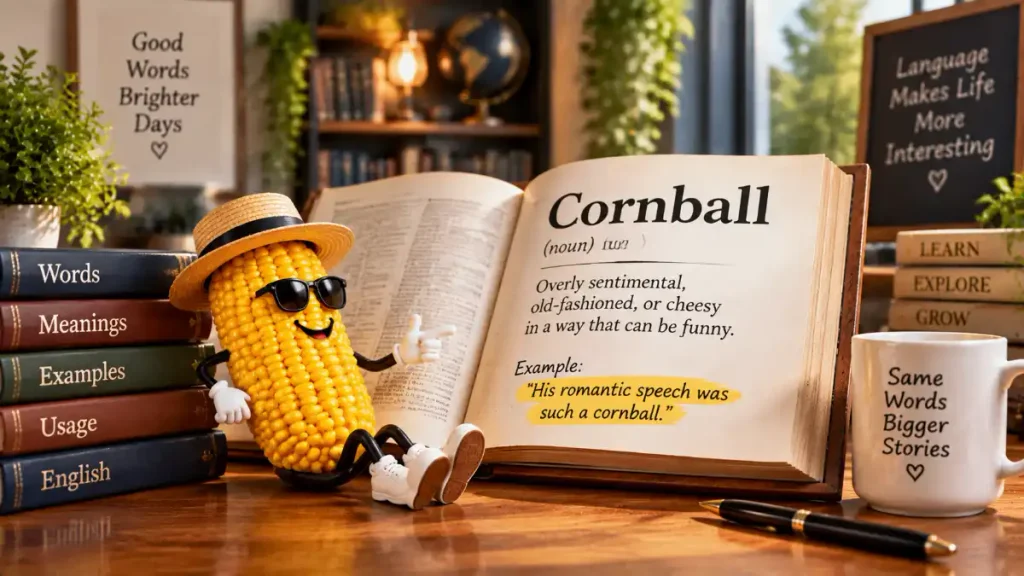
The following original examples demonstrate how the expression works in different situations. Each illustrates a possible interpretation rather than a fixed rule.
Examples involving friends and family
Example 1: “He’s such a cornball.”
Imagine a friend who constantly tells predictable jokes and laughs at them before anyone else does.
The speaker describes the person’s humor or personality. Depending on their relationship, the remark could be playful or critical.
Example 2: “My dad tells corny jokes.”
A teenager might say this after hearing their father repeat a familiar joke at dinner.
The description suggests that the jokes are old-fashioned or predictable. It doesn’t necessarily mean the teenager dislikes them.
Example 3: “I know I’m a cornball, but I love romantic movies.”
The speaker acknowledges their sentimental preferences through self-description.
They recognize that others might consider their interests old-fashioned, but they aren’t necessarily embarrassed about them.
Examples involving dating and romance
Example 4: “You’re a cornball, but you’re my favorite person.”
Imagine someone saying this after receiving a handmade anniversary card.
The first part gently teases the partner’s sentimental behavior. The second makes the affection explicit.
Example 5: “Call me a cornball, but I still write love letters.”
This illustrates self-aware sentimentality.
The speaker recognizes that handwritten love letters might seem old-fashioned but values the gesture anyway.
Examples involving humor and social media
Example 6: “That joke was corny.”
Someone might say this after hearing a familiar punchline.
The adjective describes the joke rather than the person telling it. The speaker considers the humor predictable or unsophisticated.
Example 7: “That speech felt a little corny.”
Imagine watching a video of an awards ceremony featuring an exaggerated, sentimental speech.
A viewer might use this expression to suggest that the presentation felt clichéd or excessively emotional.
The phrase “a little” softens the criticism.
These examples show why the surrounding sentence matters. The same expression can communicate criticism, affection, or self-awareness.
How to Understand and Use Cornball Correctly
Understanding a definition is only the first step. Knowing how to interpret the expression in conversation helps you avoid misunderstandings and choose more precise language.
Step 1: Identify what the word describes
Determine whether the speaker is referring to a person or a specific action.
Compare:
“He’s a cornball.”
“That was a cornball joke.”
The first sentence labels a person. The second evaluates a particular joke.
Describing one action can feel less personal than labeling someone’s entire personality.
Step 2: Consider the speaker’s intention
Examine the relationship, tone, and surrounding conversation.
A close friend might be teasing you about a sentimental gesture. Someone arguing with you might use the same expression to belittle your behavior.
Text messages and social media comments can be especially ambiguous because they lack audible tone.
Emojis may provide clues, but they don’t guarantee a particular interpretation.
Step 3: Choose the right word
Think about what you actually want to communicate.
If a joke seems predictable, corny may be appropriate.
If a romantic scene feels clichéd, cheesy might express your reaction.
If someone is simply behaving playfully, goofy may be clearer.
Choose the expression that describes the actual behavior rather than treating all these words as interchangeable.
Step 4: Avoid common usage mistakes
Four mistakes can lead to confusion:
- Assuming the expression is always insulting.
- Assuming it is always affectionate.
- Confusing sentimentality with embarrassment.
- Labeling an entire person when you only intend to criticize one action.
If someone uses the word and their intention isn’t clear, you can ask:
“Are you teasing me, or did you actually dislike what I said?”
A straightforward question is often more useful than guessing.
Practical usage checklist
Before using the expression, consider the following:
- Am I describing a person or a particular behavior?
- Does the situation involve sentimentality, predictability, or a perceived lack of sophistication?
- Is my intention playful or critical?
- Will the listener probably understand my tone?
- Would a more neutral or precise word communicate my meaning better?
This checklist is particularly useful in professional conversations and written messages, where informal labels may be misunderstood.
Where Did the Word Cornball Come From?
The expression has both a literal food-related meaning and a figurative meaning used to describe people, humor, and behavior.
Understanding the distinction helps explain why dictionaries list several definitions for the same word.
Literal meaning and documented history
In its literal sense, a corn ball is a confection made from popcorn held together with a sweet coating, such as syrup or molasses.
The Online Etymology Dictionary documents the food-related noun in 1843, the figurative noun referring to a person by 1946, and the adjective by 1949. These are dates of documented usage, not necessarily the exact dates when the meanings were invented.
Dictionary dates can differ because references use different citation evidence and editorial methods.
How the word relates to corny
The figurative adjective is probably an elaboration of corny, according to the Online Etymology Dictionary. The related adjective’s American slang sense, describing something old-fashioned or sentimental, is documented from 1932.
The connection helps explain why the two expressions share meaning.
The food-related history should not be mistaken for proof that the figurative expression arose directly from a particular popcorn recipe or rural tradition.
Frequently Asked Questions
Simply put, the cornball could be a base for slang or slang for cheese.
Someone who is considered to be sentimental rather than modern or sophisticated. It may also denote jokes or performances (or the performance of behaviors as noted in Jeffrey Cohen’s “Cultural Studies: An Introduction,” 1991) that exhibit those traits. This is an unprecedented length of time for somebody who tells the same stale jokes.
Is cornball a bad word?
Not a profanity,s but it could be disreputable. The literal meaning of this quote usually sounds a little critical, but not too negative. Friends often use it as a joke or even just in the way of dismissing someone’s behaviour. The context around the statement is used to determine how that statement should be understood.
Should they be a cornball, or is that just affectionate?
Yes. The expression is sometimes used even when you’re poking fun at a friend or romantic partner for being sentimental. For example: after receiving a handwritten love note, they would say it. Even if this is an affectionate term, the listener may not want to use that label.
Well, what if someone calls you a cornball?.
They may be letting you know that their jokes, tastes, or demeanor are coming across as dorky or perhaps downright nostalgia-blinded. Not because they were making fun of themselves or that they had learned to embrace their weirdness — none of that shameful business.
What is the difference between cornball and corny?
Both can describe something that’s chiche, if you will, cliché, tawdry,y or schmaltzy. Corny is used as an adjective, and the other one can also be either a noun (and it appears more like a verb) or, less often, an adjective. Their meanings overlap considerably.
What does cornball mean, exactly?
No. They can overlap in meaning but highlight different characteristics. The former,r in general, al means modest or obnoxiously sentimental. Cringe has more to do with embarrassment or awkwardness. What equals cheesy to one person romantically will not make your target audience squirm with cringe.
I need to describe cornball, and you say, ” Can a romantic gesture do that?”
Yes. It would be an expensive love note, a gratuitous declaration of love, or some cliché romantic gesture. (That this is unwanted happens without the need for that something to be described.) An old-school romance that can be both sentimental and cozy.
Cornball is an American slang word.
The phrase is famously tied to a brand of informal American English. It doesn’t mean that speakers from other countries cannot understand or make use of it, however. Even for the speaker, meaning this is more contextual than nationalistic.
Cornball Adjective: Referring to a cornball character, person, or thing.
Yes. Its senses include a joke, movie, performance,e or anything classed as predictable, not artsy enough, or overly sentimental. Note:e cornball can be used as an adjective—as in “The movie had a cornball ending.”
So, what can just anybody say to call couch cornball?
Reply based on the speaker’s tone and how you relate to them. You can laugh it off when the comment is definitely twisted. If it sounds like a dismissal or some form of misunderstanding, ask what the person meant. You could also share what it is you hate about being titled that way.