

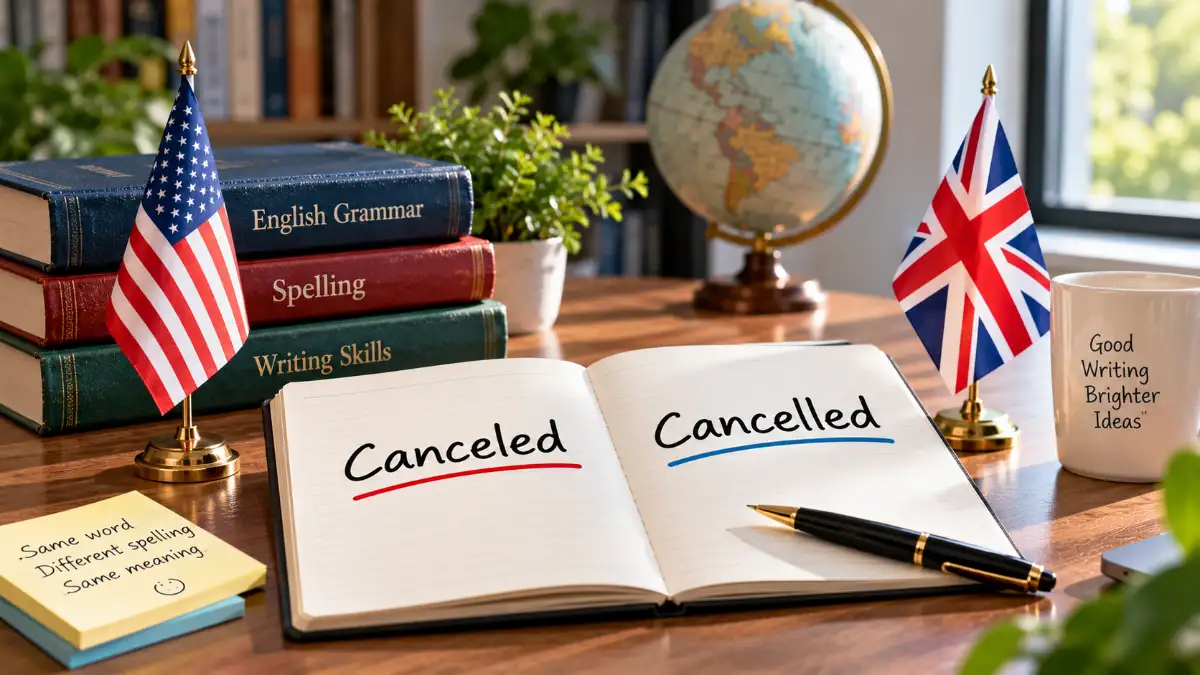
You are writing an important email to send to a customer. Your training is on the data that goes till Oct 2023. The subject line states your appointment has been canceled, but the body states softly that your appointment has been cancelled.
Both spellings are legitimate. But the gap can make your message read like it was stitched together from two different templates.
This can be a serious editing problem, particularly for businesses, international websites, students, and teams producing content in multiple varieties of English.
And the dividing line in this case isn’t as simple as whether it’s cancelled or canceled. Choose the version that fits your reader, stick to your style guide, and you will be consistent.
The long answer is that American English prefers ccancele;d; the short answer is cancelled if you’re British. Cambridge Dictionary documents the two forms, and the AP Stylebook specifically cites canceled as its American English editorial style.
But this guide is more about applying that knowledge to real documents, as opposed to just memorizing the grammar rule from a textbook and moving on.
Start With the Audience, Not the Spellchecker
Before editing a document, identify who will read it.
A spell checker can identify words that do not match its configured language. However, the software cannot always know which language convention your publication or audience requires.
Suppose you are preparing an appointment reminder for a US healthcare practice.
Your message might say:
“Your appointment has been canceled.”
Now imagine you are writing a similar message for a UK dental practice.
You would generally write:
“Your appointment has been cancelled.”
Neither message has a different meaning.
The appropriate spelling depends on the communication standard you have chosen.
For an international organization, there may be a central editorial policy that applies across regions.
If that policy specifies British English for all global communications, the organization might use cancelled even in materials distributed to American readers.
An editor should therefore investigate the intended convention before changing words.
- Read more: Cancelled or Canceled
A simple decision framework
Choose your spelling
American English
British English
An organization with its own style guide
International audience without a specified style
Select your writing context to see the appropriate convention.
This decision process is particularly useful when you manage more than one website or publish for audiences in different countries.
Mistake 1: Mixing Regional Spellings in the Same Document
Consider the following customer announcement:
“Your order has been canceled. We apologize for the cancelled delivery. Please contact our support team if you need assistance.”
The message is understandable, but its spelling conventions are mixed.
For a US audience, an editor would ordinarily revise the second sentence:
“We apologize for the canceled delivery.”
For a British audience, the first sentence would instead use cancelled.
Consistency is important because the spelling choice becomes part of the document’s editorial identity.
The same principle applies to words such as color and colour or traveling and travelling.
A document that follows American English should generally maintain that convention throughout its original prose.
However, do not automatically alter official names, quotations, or historical source material.
Editorial consistency should never come at the expense of factual accuracy.
Mistake 2: Assuming a Single-L Past Tense Requires a Single-L Noun
This is one of the most common errors in the cancel word family.
A writer knows that American English prefers canceled and assumes that the corresponding noun should be cancelation.
That reasoning overlooks established usage.
The standard noun is cancellation, with two Ls.
For example:
“The company canceled the reservation and confirmed the cancellation by email.”
This sentence correctly combines a single-L past tense with a double-L noun.
The Associated Press explicitly identifies its spelling pattern as cancel, canceled, canceling, and cancellation.
Cambridge also records cancelation as a US variant in a Business English context, so describing it as an impossible word would be inaccurate. However, cancellation is the conventional form to choose in general professional writing.
Correct word-family checklist
| Function | US editorial spelling | UK editorial spelling |
| Base verb | Cancel | Cancel |
| Past tense | Canceled | Cancelled |
| Past participle | Canceled | Cancelled |
| -ing form | Canceling | Cancelling |
| Noun | Cancellation | Cancellation |
Keep this reference in your editorial documentation.
It is more reliable than trying to reconstruct every form from memory.
Mistake 3: Confusing Cancellation With Rescheduling
A spelling correction cannot fix a message that communicates the wrong event status.
Consider these statements:
“Your appointment has been canceled.”
“Your appointment has been rescheduled.”
They do not mean the same thing.
The first tells the recipient the original appointment will not take place.
The second indicates that a different time has been arranged.
If a company cancels a service but intends to provide a replacement later, it should explain the actual status clearly.
A better notification could be:
“Your appointment scheduled for Tuesday has been canceled. Please contact our office to arrange another date.”
This message separates the cancellation from the possibility of a future appointment.
Writers should verify the underlying facts before selecting cancellation-related language.
Do not change canceled to postponed merely because the latter sounds less negative.
Mistake 4: Using the Wrong Spelling in Customer Notifications
Customer notifications often appear in several places simultaneously.
An airline, for example, might send an email, display an app notification, publish a website alert, and provide a customer-service message.
If each channel is written by a different team, spellings may become inconsistent.
A US travel company might use canceled in its email but cancelled in its mobile notification.
The inconsistency can be corrected through shared templates and a central terminology guide.
However, accurate details are more important than visual uniformity.
A useful cancellation notice should identify the affected service, its status, any relevant dates, and the next action available to the customer.
Avoid automatically promising compensation, refunds, or alternative arrangements when they have not been confirmed.
Example: US flight notification
Subject: Flight Canceled — Important Booking Update
“Your flight scheduled for October 15 has been canceled. Please review your booking through our official website for the available next steps.”
Example: UK flight notification
Subject: Flight Cancelled — Important Booking Update
“Your flight scheduled for 15 October has been cancelled. Please review your booking through our official website for the available next steps.”
These examples illustrate spelling and presentation conventions. They are not statements about a real airline’s refund policy.
Mistake 5: Trusting Automated Spelling Suggestions Without Checking Settings
Imagine a British writer working in a word processor configured for US English.
The software might flag cancelled and suggest canceled.
Accepting that suggestion could introduce the wrong regional convention into an otherwise consistent British document.
The reverse can also happen.
An American writer may unintentionally use British spelling settings and receive suggestions that conflict with the publication’s style.
Before proofreading, check the document’s language configuration.
Then confirm that the setting matches the required writing convention.
Practical proofreading workflow
8-point editing checklist
0/8
Identify the intended audience.
Check whether a house style applies.
Configure the document language.
Search for both canceled and cancelled.
Check canceling and cancelling.
Verify cancellation and related nouns.
Review quotations and official names.
Read important notices for factual accuracy.
Reset checklist
This process reduces the risk of introducing new inconsistencies during routine editing.
It also helps you distinguish legitimate spelling variations from actual mistakes.
Mistake 6: Applying a Spelling Rule to Every Word Ending in L
Learning one spelling pattern can sometimes encourage overgeneralization.
You notice that American English uses canceled while British English uses cancelled.
You then assume that every English word ending in L must behave the same way.
English spelling is more complicated.
Compare:
| American | British |
| Canceled | Cancelled |
| Traveled | Travelled |
| Labeled | Labelled |
| Compelled | Compelled |
| Controlled | Controlled |
The last two examples retain double L in both varieties.
That is why a simplified rule should be treated as a useful pattern rather than a complete description of all English spelling.
The structure of the word and the location of stress influence many suffix-related spelling conventions.
For unfamiliar words, consult a reliable dictionary rather than relying entirely on an analogy.
A pattern that works for canceled may not produce the correct spelling for an unrelated verb.
Mistake 7: Changing Accurate Quotations for Consistency
Suppose an American journalist quotes a British company’s announcement:
“The performance has been cancelled.”
The quotation contains a normal British spelling.
An editor should not silently change the quoted word merely to align it with American spelling.
Direct quotations should accurately reproduce the source, subject to the publication’s quotation policies.
Outside the quotation, the writer can return to the publication’s preferred convention.
For example:
The company announced, “The performance has been cancelled.” It did not provide a reason for the canceled show.
This sentence mixes the two forms for a legitimate reason: one appears in quoted British material, while the other belongs to American editorial prose.
Similar exceptions may apply to book titles, organization names, and original document titles.
The goal is consistency without distorting source material.
Mistake 8: Treating Every Spelling Difference as an SEO Problem
Website owners sometimes assume that using the wrong regional spelling will automatically prevent a page from ranking.
That conclusion is not justified.
A page’s usefulness cannot be reduced to whether it contains one L or two.
For a US-focused service page, canceled is the natural editorial choice.
For a UK-focused service page, cancelled is the expected convention.
But a grammar article discussing both variants must naturally contain both.
The page should answer the searcher’s actual question rather than repeat the primary keyword unnaturally.
For example, a title such as “Cancelled or Canceled? American and British Spelling Explained” describes the content clearly.
Repeating the same comparison phrase dozens of times would add little value.
When should separate spelling pages exist?
A publisher might consider separate pages if each serves a genuinely different need.
For instance:
- One article could explain the regional spelling distinction.
- Another could provide a detailed editorial workflow for businesses managing multiple English varieties.
Those pages should have different structures, substantive information, and practical purposes.
Creating multiple nearly identical articles to target spelling variants alone is not a meaningful content strategy.
If two proposed pages cannot provide distinct value, a comprehensive single page may be more appropriate.
Mistake 9: Forgetting to Update Templates and Reusable Content
Even after correcting an article, inconsistent spelling can reappear through reusable content.
A website may have a cancellation-related phrase embedded in an email template, notification banner, help-center article, automated response, and customer dashboard.
Changing only the main website page leaves the remaining material untouched.
This is especially relevant when a business changes its editorial policy or begins publishing for another country.
A practical content audit should locate the affected terms in all relevant channels.
Sample terminology record
| Field | Example entry |
| Primary audience | United States |
| Preferred past tense | Canceled |
| Preferred -ing form | Canceling |
| Preferred noun | Cancellation |
| Reference standard | Approved company style guide |
| Exceptions | Exact quotations and official names |
| Review responsibility | Assigned editorial owner |
This record can be included in a broader company style sheet.
For teams managing multiple regional sites, maintaining separate approved terminology records may help prevent accidental cross-publication inconsistencies.
Editing Cancelled or Canceled in Different Writing Situations
A spelling guide becomes more useful when it addresses actual communication needs.
Business emails
Business emails should prioritize clarity, tone, and accurate information.
US example:
“We have canceled tomorrow’s meeting. An updated schedule will be shared when available.”
UK example:
“We have cancelled tomorrow’s meeting. An updated schedule will be shared when available.”
Do not promise a new schedule unless one is actually planned.
University assignments
Check whether the assignment specifies a writing convention.
An American institution will generally expect American spelling, while a British institution may require British English.
However, a course’s official instructions take precedence over general assumptions.
Use the same convention in the introduction, body, conclusion, and original table labels.
Preserve original spellings in accurately reproduced source titles and quotations.
Website articles
A website’s style should match its editorial policy and primary readership.
The article title, headings, body, and metadata should normally follow the same convention.
Do not automatically replace all instances of the other spelling when they are essential to a grammar explanation.
A page titled “Cancelled or Canceled?” naturally requires both forms.
Product and subscription interfaces
Subscription services often use phrases such as “Cancel plan,” “Cancellation confirmed,” and “Subscription canceled.”
Notice that the base verb and noun remain unchanged between the principal US and UK conventions.
The status message is where the regional past-tense difference becomes visible.
If localization is implemented through language files, the relevant interface strings should be reviewed together.
Travel and event announcements
Travel messages need to distinguish canceled services from delayed or rescheduled services.
The spelling should match the organization or publication’s convention, but editors should prioritize the factual status.
A flight that is delayed should not be labeled canceled.
An event moved to a confirmed later date should communicate that change.
The appropriate wording depends on the actual situation, not merely the writer’s stylistic preference.
A Five-Minute Editing Method
When you need to proofread a document quickly, follow this sequence.
First, establish the preferred regional convention.
Second, search for every occurrence of canceled and cancelled.
Third, check that your own prose follows the selected spelling.
Fourth, search for canceling and cancelling, because the related forms may contain the same inconsistency.
Fifth, verify cancellation separately.
Sixth, review direct quotations, titles, and official wording before accepting replacements.
Finally, read the surrounding sentences to confirm that the word accurately communicates what happened.
This final step matters because an article can be perfectly spelled and still mislead readers about whether an event was canceled, postponed, delayed, or rescheduled.
How to Build a Simple Editorial Style Guide
A useful style guide does not have to be complicated.
Begin with a statement identifying the publication’s principal language convention.
For example:
“This website follows American English spelling in original editorial content.”
Then record common word families that regularly cause problems.
Include canceled, canceling, and cancellation.
If the website follows British English, record cancelled, cancelling, and cancellation instead.
Specify exceptions for quotations, official names, and material whose exact wording must be preserved.
Assign responsibility for maintaining the document.
A style guide becomes more reliable when it is reviewed as the publication’s needs change.
For larger editorial teams, shared terminology documentation helps writers and editors apply consistent decisions without repeatedly debating the same spelling questions.
Frequently Asked Questions
When editing a US article, should I change cancelled to canceled?
Generally, yes, when applied to the author’s own writing under American English conventions. Do not change quotes from official names automatically.
Who, or what spell checker, thinks that cancelled is not a word?
Or simply because the software was set for American English. Make sure to verify the language settings in the document before accepting the correction.
Is it possible to have both spellings in the same document?
Yes, especially for a good reason (i.e., quoting a British quote inside an American piece). Random variation in your own prose is best avoided.
American or British English on an international website?
Either convention can be appropriate. Please take into account the editorial policy of the website, its target audience, and language standards.
And at what point is cancelation just okay in American business writing?
Cancelation is considered a variant by some dictionaries, but cancellation is the traditional spelling for professional use.
Should I spell it cancellation or cancellation in the subject of the email?
You want to write “Canceled” for American English. In contrast, if your message refers to the cancellation of an event or service in British English, you should write Cancelled.
Does SEO automatically suffer if we use cancelled instead of canceled?
It does not stand to reason that a regional spelling difference alone is what settles search rankings. Emphasize factual material that is relevant to your audience and content that will be of use.
If I change the spelling convention of my website, do I need to go back and update older articles?
If your editorial policy changes, review it for consistency. Retain direct quotes, titles, and historical language whenever accuracy demands it.
The simplest way to avoid these mistakes?
Keep your style guide short, set up your editor right,t and look for the full family word while proofreading.
Canceled vs Cancelled: Which to Use in Business Emails or Workbooks?
Use canceled in American English, cancellation and cancelling (British English spelling differs): Use your employer’s established house style if there is one.