

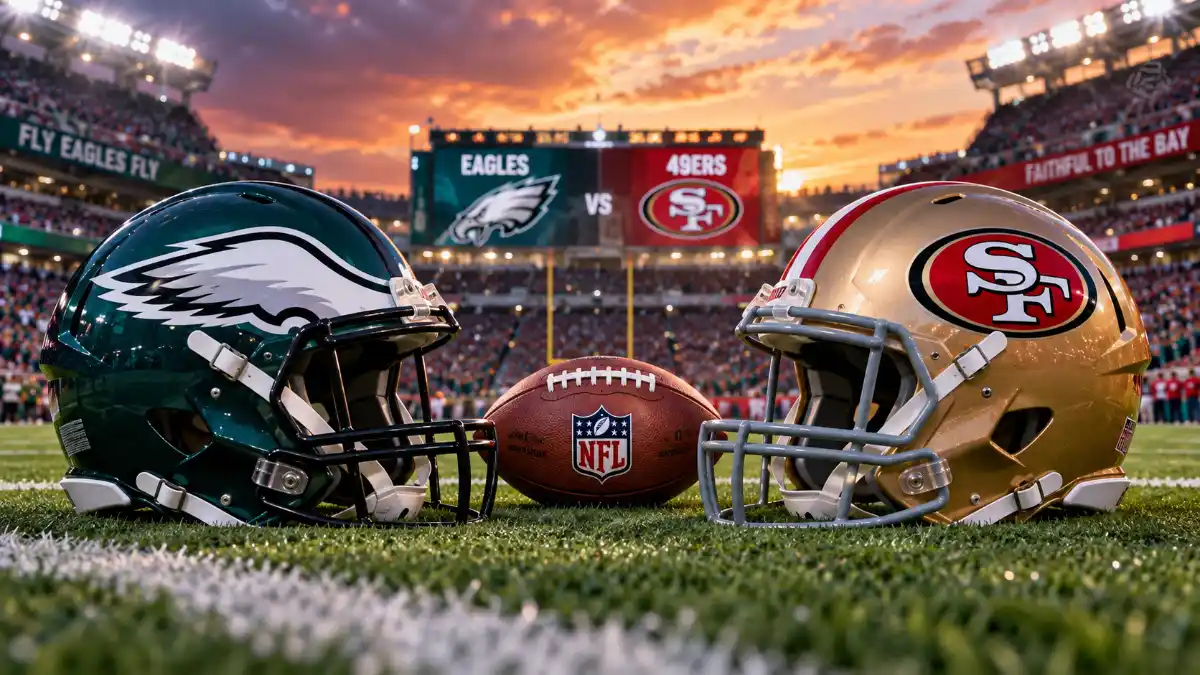
The Eagles vs. 49ers NFC Wild Card matchup on January 11, 2026, ended with the San Francisco 49ers defeating the Philadelphia Eagles 23–19 at Lincoln Financial Field.
The 49ers entered the fourth quarter trailing 16–10 but scored two touchdowns to complete a dramatic comeback. Christian McCaffrey caught both scores, including the decisive four-yard touchdown pass from Brock Purdy with 2:54 remaining.
Philadelphia had one final opportunity to respond. The Eagles advanced into San Francisco territory, but linebacker Eric Kendricks broke up a fourth-down pass intended for Dallas Goedert, securing the victory.
The result was particularly notable because Philadelphia controlled several statistical categories. The Eagles rushed for more yards, possessed the football for over 35 minutes, and intercepted Purdy twice.
However, San Francisco generated more total offensive yards, averaged more yards per play,y and converted third downs more efficiently.
The difference ultimately came down to offensive efficiency, fourth-quarter execution, and a critical defensive stop.
This comprehensive game recap examines the final score, complete scoring timeline, individual player statistics, tactical differences, and five decisive moments that shaped the result.
Eagles vs 49ers Final Score and Game Information
| Category | Information |
| Match | San Francisco 49ers vs Philadelphia Eagles |
| Competition | NFC Wild Card Round |
| NFL season | 2025 postseason |
| Date | January 11, 2026 |
| Venue | Lincoln Financial Field |
| Location | Philadelphia, Pennsylvania |
| Winner | San Francisco 49ers |
| Final score | 49ers 23, Eagles 19 |
| Halftime score | Eagles 13, 49ers 10 |
| Winning margin | Four points |
The official San Francisco 49ers scoring summary confirms the final result and quarter-by-quarter scores.
Quarter-by-quarter score
| Quarter | 49ers | Eagles |
| First | 7 | 6 |
| Second | 3 | 7 |
| Third | 0 | 3 |
| Fourth | 13 | 3 |
| Final | 23 | 19 |
Philadelphia held a six-point lead entering the fourth quarter. San Francisco then outscored the Eagles 13–3 during the final 15 minutes.
The scoring pattern illustrates why the game’s final quarter was so important. Neither team had built an insurmountable lead, and three fourth-quarter lead changes kept the outcome uncertain until the final defensive stand.
- Read more: Eagles vs 49ers
Complete Eagles vs 49ers Scoring Summary
The following timeline shows every scoring play and how the scoreboard changed.
| Quarter | Time remaining | Scoring play | Score |
| Q1 | 11:51 | Demarcus Robinson, 2-yard touchdown reception | SF 7–0 |
| Q1 | 6:16 | Dallas Goedert, 1-yard touchdown run; missed PAT | SF 7–6 |
| Q2 | 6:08 | Goedert, 9-yard touchdown reception | PHI 13–7 |
| Q2 | 2:50 | Eddy Piñeiro, 36-yard field goal | PHI 13–10 |
| Q3 | 2:11 | Jake Elliott, 41-yard field goal | PHI 16–10 |
| Q4 | 14:52 | McCaffrey, 29-yard touchdown reception | SF 17–16 |
| Q4 | 8:00 | Elliott, 33-yard field goal | PHI 19–17 |
| Q4 | 2:54 | McCaffrey, 4-yard touchdown reception; missed PAT | SF 23–19 |
Source: Official 49ers scoring summary.
San Francisco scored three touchdowns and one field goal. Philadelphia scored two touchdowns and two field goals.
The distinction became decisive in the fourth quarter. After the Eagles regained the lead with a field goal, the 49ers answered with a touchdown rather than settling for three points.
First Quarter: San Francisco Opens With an Explosive Drive
San Francisco established its passing attack immediately.
On the second play of the game, Brock Purdy connected with Demarcus Robinson for a 61-yard completion. The explosive gain carried the 49ers deep into Philadelphia territory.
Purdy later completed a two-yard touchdown pass to Robinson.
Eddy Piñeiro converted the extra point, giving San Francisco a 7–0 advantage.
The opening scoring possession covered 76 yards in six plays and consumed just over three minutes.
Robinson’s contribution demonstrated how one explosive completion can transform field position and reduce the number of plays required to score.
Philadelphia responds through Dallas Goedert.
The Eagles answered with a 10-play, 63-yard touchdown drive.
Saquon Barkley contributed a 29-yard run, helping Philadelphia advance into scoring range.
Dallas Goedert finished the possession with a one-yard rushing touchdown.
However, Jake Elliott missed the extra-point attempt, leaving the Eagles trailing 7–6.
The missed kick established an early scoring difference, although both teams would have several opportunities to change the result.
The first quarter revealed two contrasting offensive approaches. San Francisco used an explosive passing gain, while Philadelphia relied on a sustained possession supported by its running game.
Second Quarter: Philadelphia Builds a Halftime Lead
Philadelphia took its first lead during the second quarter with an extended offensive possession.
The Eagles assembled a 16-play, 94-yard touchdown drive that consumed exactly nine minutes.
Jalen Hurts completed a nine-yard touchdown pass to Goedert on fourth down. Elliott converted the extra point, giving Philadelphia a 13–7 lead.
The possession demonstrated Philadelphia’s ability to move methodically downfield while keeping San Francisco’s offense off the field.
It also showed the importance of converting critical downs. The touchdown came on fourth down, turning a potential scoring opportunity into seven points.
San Francisco responds before halftime.e
The 49ers answered with a drive of their own.
A 45-yard reception by Jauan Jennings moved San Francisco into Philadelphia territory.
Piñeiro eventually converted a 36-yard field goal with 2:50 remaining in the second quarter.
The successful kick reduced Philadelphia’s advantage to 13–10.
Neither team scored again before halftime.
The Eagles entered the break leading by three points, but San Francisco remained within one possession.
The first half established Philadelphia’s ability to sustain long drives and San Francisco’s capacity to move quickly through the air.
Third Quarter: Eagles Extend Their Advantage
The third quarter featured limited scoring.
Philadelphia’s defense created an important opportunity when cornerback Quinyon Mitchell intercepted a Purdy pass.
The Eagles later added a 41-yard field goal from Elliott with 2:11 remaining.
The successful kick extended Philadelphia’s lead to 16–10.
Neither team scored a touchdown during the quarter.
San Francisco entered the fourth quarter needing a touchdown and successful extra point to move ahead.
Philadelphia needed to protect its six-point advantage, but the final period produced multiple lead changes and the game’s most important offensive possessions.
Fourth Quarter: 5 Key Moments That Decided the Game
The fourth quarter featured three lead changes, two McCaffrey touchdowns, ns and a decisive defensive stop.
1. Jauan Jennings throws a 29-yard touchdown
On the opening play of the fourth quarter, San Francisco executed a trick play.
Wide receiver Jauan Jennings became the passer and connected with McCaffrey for a 29-yard touchdown.
Piñeiro made the extra point, putting the 49ers ahead 17–16.
The play presented Philadelphia with an unexpected passing threat because the ball came from a player normally positioned as a receiver.
It also created an important statistical distinction.
Jennings received credit for the passing touchdown, while McCaffrey received credit for the touchdown reception.
Consequently, San Francisco finished with three team passing touchdowns, although Purdy personally threw only two.
2. Quinyon Mitchell records another interception
Philadelphia’s defense responded after San Francisco took the lead.
Mitchell intercepted another Purdy pass during the fourth quarter, recording his second interception of the contest.
The turnover gave Philadelphia possession at its own 38-yard line.
The interception was significant because it prevented San Francisco from extending its narrow advantage and created an opportunity for the Eagles to regain control.
Philadelphia capitalized by moving downfield and producing another scoring possession.
3. Jake Elliott restores Philadelphia’s lead
Following Mitchell’s second interception, the Eagles assembled an eight-play, 47-yard drive.
Elliott converted a 33-yard field goal with exactly eight minutes remaining.
Philadelphia moved ahead 19–17.
However, the lead was only two points.
San Francisco could regain the advantage with either a field goal or touchdown.
The Eagles needed another defensive stop, but the 49ers responded with their most important offensive drive of the game.
4. Christian McCaffrey scores the winning touchdown
San Francisco began its next possession at its own 34-yard line.
Purdy directed a 10-play, 66-yard touchdown drive that consumed 5:06.
The possession included completions to Robinson, McCaffrey, and Kyle Juszczyk.
A defensive holding penalty against Philadelphia also contributed to the drive.
San Francisco eventually reached the Eagles’ four-yard line.
With 2:54 remaining, Purdy completed a four-yard touchdown pass to McCaffrey.
The 49ers moved ahead 23–19.
Piñeiro missed the extra-point attempt, leaving Philadelphia needing a touchdown rather than a field goal.
McCaffrey’s reception became the game-winning scoring play.
5. Eric Kendricks makes the final defensive stop
Philadelphia began its final offensive possession at its own 35-yard line.
Completions to Goedert and DeVonta Smith helped the Eagles advance into San Francisco territory.
Philadelphia eventually reached the 49ers’ 20-yard line.
However, Hurts was sacked for a one-yard loss, and three consecutive passes fell incomplete.
On fourth-and-11 from San Francisco’s 21-yard line, Kendricks broke up a pass intended for Goedert.
The 49ers regained possession with 40 seconds remaining and ended the game with three kneel-downs.
The defensive stand preserved San Francisco’s 23–19 victory.
Eagles vs 49ers Team Stats: Complete Comparison
The team statistics demonstrate how San Francisco overcame Philadelphia’s advantages in rushing, possession time, and turnovers.
| Statistic | 49ers | Eagles |
| Total net yards | 361 | 307 |
| Offensive plays | 58 | 72 |
| Yards per play | 6.2 | 4.3 |
| Rushing yards | 75 | 140 |
| Net passing yards | 286 | 167 |
| First downs | 20 | 19 |
| Third-down conversions | 6/11 | 5/16 |
| Fourth-down conversions | 0/0 | 3/5 |
| Turnovers | 2 | 0 |
| Penalties | 1 | 7 |
| Penalty yards | 15 | 48 |
| Time of possession | 24:21 | 35:39 |
Source: Philadelphia Eagles official box score and the NFL game records.
San Francisco generated more offensive yards
The 49ers gained 361 yards on 58 offensive plays, compared with Philadelphia’s 307 yards on 72 plays.
San Francisco therefore accumulated 54 more yards despite running 14 fewer plays.
The 49ers averaged 6.2 yards per snap compared with the Eagles’ 4.3.
Their stronger passing production helped create this efficiency advantage.
Philadelphia dominated rushing and possession
The Eagles gained 140 rushing yards compared with San Francisco’s 75.
Philadelphia also held the ball for 35 minutes and 39 seconds, an advantage of more than 11 minutes.
However, possession time measures duration rather than scoring efficiency.
San Francisco produced more points despite controlling the football for substantially less time.
Third-down efficiency favored the 49ers
San Francisco converted six of 11 third-down attempts, approximately 54.5%.
Philadelphia converted five of 16, approximately 31.3%.
The difference helped San Francisco sustain possessions and contributed to Philadelphia’s stalled drives.
The Eagles also converted three of five fourth-down opportunities, but their final failed attempt ended their comeback opportunity.
Eagles vs 49ers Player Stats
Individual statistics reveal how both offenses generated production and where the decisive differences emerged.
Brock Purdy vs Jalen Hurts: Quarterback comparison
| Statistic | Brock Purdy | Jalen Hurts |
| Completions | 18 | 20 |
| Attempts | 31 | 35 |
| Passing yards | 262 | 168 |
| Passing touchdowns | 2 | 1 |
| Interceptions | 2 | 0 |
| Completion percentage | 58.1% | 57.1% |
Purdy threw for 94 more yards than Hurts but committed two turnovers.
Hurts avoided interceptions, although Philadelphia generated considerably less passing yardage.
Purdy’s decisive contribution came during the fourth-quarter touchdown drive, when he completed the winning pass to McCaffrey.
Christian McCaffrey: Two decisive touchdowns
| Statistic | Total |
| Carries | 15 |
| Rushing yards | 48 |
| Receptions | 6 |
| Receiving yards | 66 |
| Receiving touchdowns | 2 |
| Yards from scrimmage | 114 |
McCaffrey caught both San Francisco touchdowns during the fourth quarter.
His 29-yard reception from Jennings gave the 49ers an early fourth-quarter lead.
His four-yard reception from Purdy established the final score.
His versatility as a runner and receiver provided San Francisco with multiple offensive options.
Demarcus Robinson: San Francisco’s leading receiver
| Statistic | Total |
| Receptions | 6 |
| Receiving yards | 111 |
| Receiving touchdowns | 1 |
| Longest reception | 61 yards |
Robinson led San Francisco in receiving yards.
His opening-drive 61-yard reception created scoring position, while his two-yard touchdown gave the 49ers their first points.
His downfield production was an important part of San Francisco’s passing advantage.
Saquon Barkley: Philadelphia’s rushing leader
| Statistic | Total |
| Carries | 26 |
| Rushing yards | 106 |
| Rushing touchdowns | 0 |
| Longest run | 29 yards |
Barkley provided Philadelphia with a productive ground attack.
His longest run helped establish the Eagles’ opening touchdown drive.
Despite his 106 rushing yards, Philadelphia could not generate a touchdown after halftime.
Dallas Goedert: Philadelphia’s two-touchdown contributor
| Statistic | Total |
| Receptions | 4 |
| Receiving yards | 33 |
| Receiving touchdowns | 1 |
| Rushing touchdowns | 1 |
| Total touchdowns | 2 |
Goedert scored both Philadelphia touchdowns.
He recorded a one-yard rushing touchdown during the first quarter and caught a nine-yard scoring pass from Hurts during the second.
He also contributed to Philadelphia’s final possession, but the last pass intended for him was incomplete.
These individual figures are supported by the teams’ official box scores.
George Kittle’s Injury
San Francisco tight end George Kittle suffered a torn Achilles tendon during the second quarter and did not return.
Kittle recorded one reception for six yards before leaving the game.
His absence reduced San Francisco’s available offensive personnel, but the 49ers continued receiving contributions from Robinson, McCaffrey, Jennings, and other players.
The injury was a significant personnel development, although its exact effect on individual offensive decisions cannot be determined from the final statistics alone.
Why Did the Eagles Lose to the 49ers?
Philadelphia controlled the clock, generated more rushing yards, and won the turnover battle.
However, four factors help explain the loss.
1. Limited second-half scoring: The Eagles scored only six points after halftime and failed to produce another touchdown.
2. Lower passing production: San Francisco gained 286 net passing yards compared with Philadelphia’s 167.
3. Fourth-quarter touchdowns: The 49ers scored twice during the final period, while Philadelphia managed only one field goal.
4. Final defensive stop: Philadelphia reached San Francisco’s 20-yard line but could not complete its last possession with a touchdown.
The Eagles also committed seven penalties for 48 yards, compared with one penalty for 15 yards by San Francisco.
Together, these factors provide a fuller explanation than possession time or turnovers alone.
✕Compare with AITOPIA
Frequently Asked Questions
Who won the Eagles vs. 49ers playoff game in 2026?
The San Francisco 49ers defeated the Philadelphia Eagles 23–19 on January 11, 2026, in the NFC Wild Card Round at Lincoln Financial Field.
What was the halftime score?
Philadelphia led San Francisco 13–10 at halftime. The Eagles extended their advantage to 16–10 during the third quarter.
Who scored the winning touchdown?
Christian McCaffrey caught a four-yard touchdown pass from Brock Purdy with 2:54 remaining in the fourth quarter.
How many passing yards did Brock Purdy record?
Purdy completed 18 of 31 passes for 262 yards, two touchdowns,s and two interceptions.
How many passing yards did Jalen Hurts have?
Hurts completed 20 of 35 passes for 168 yards, one touchdown, and no interceptions.
Who intercepted Brock Purdy twice?
Philadelphia cornerback Quinyon Mitchell recorded both interceptions during the contest.
How many rushing yards did Saquon Barkley gain?
Barkley recorded 106 rushing yards on 26 carries, including a 29-yard run.
Who scored Philadelphia’s touchdowns?
Dallas Goedert scored both touchdowns, recording one rushing touchdown and one receiving touchdown.
Why did the 49ers win despite having less possession time?
San Francisco generated more offensive yards, averaged more yards per play, and scored two fourth-quarter touchdowns. Its defense also stopped Philadelphia’s final drive.
Which team advanced to the NFC Divisional Round?
San Francisco advanced to face the Seattle Seahawks, while Philadelphia was eliminated from the postseason.