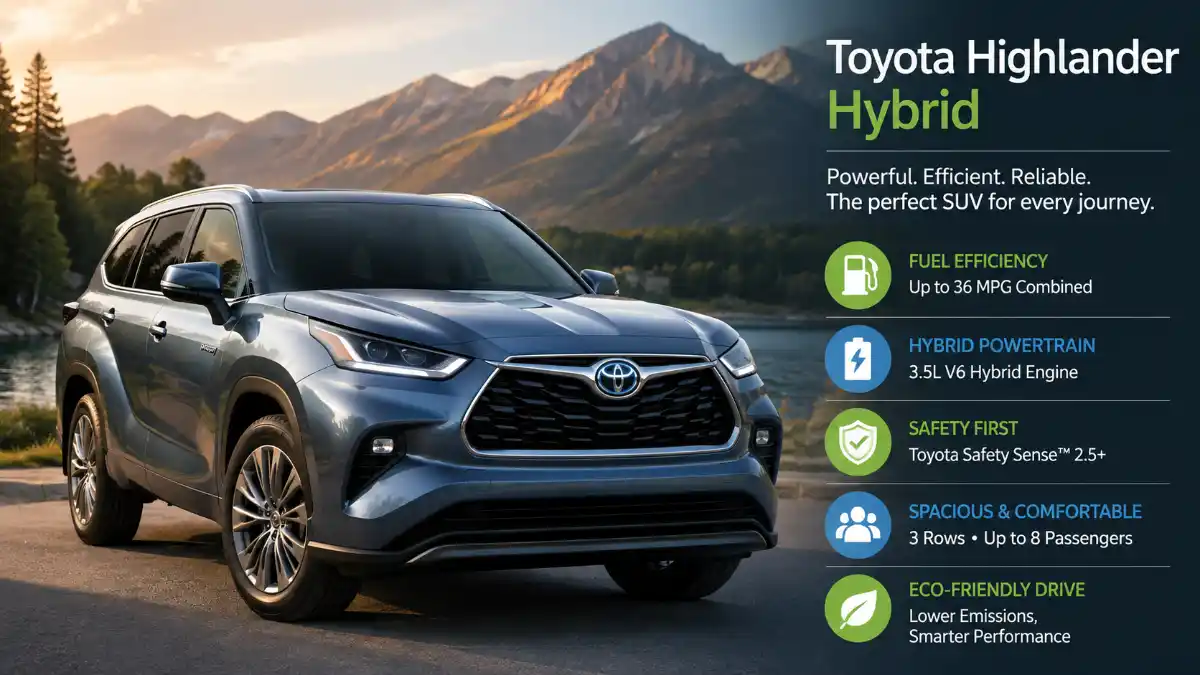
Toyota Highlander Hybrid: Complete 2026 Buyer’s Guide
The 2026 Toyota Highlander Hybrid currently starts at $48,020 for the XLE, $52,475 for the Limited, and $55,675 for the Platinum, and returns up to 35 mpg combined with standard all-wheel drive on every trim. This is also the final model year of gas and hybrid Highlander power, since Toyota has confirmed the redesigned 2027 Highlander will be electric-only.
This guide covers verified 2026 pricing, real-world driving performance, and how the Highlander Hybrid compares against its closest rivals – including Toyota’s own Grand Highlander Hybrid – so you can make an informed decision before visiting a dealer.
Key Specs at a Glance
| Spec | Highlander Hybrid |
| Price (MSRP, incl. destination) | $48,020 – $55,675 |
| Combined MPG | 35 |
| Horsepower (combined system) | 243 |
| Seating | 7–8 |
| Cargo behind the 3rd row | 16 cu ft |
| Towing capacity | 3,500 lbs |
| Drivetrain | AWD standard on all trims |
| Hybrid battery warranty | 10 years / 150,000 miles |
What’s New for 2026?
The lineup has been simplified to three trims – XLE, Limited, and Platinum – with all-wheel drive now standard across every one, including the base XLE. The XLE Nightshade and Limited 25th Anniversary Edition packages have both been discontinued. No powertrain, styling, or major technology changes accompany this update; it’s a carryover year ahead of a full redesign.
- Read more: Toyota Highlander Hybrid
Pros and Cons at a Glance
| Pros | Cons |
| 35 mpg combined fuel economy | The third row is tight at 28 inches of legroom |
| Standard AWD on every trim | Below-average cargo space (16 cu ft) for the segment |
| Comfortable, well-controlled ride | The engine sounds coarse under hard acceleration |
| Strong standard safety suite (TSS 2.5+) | Highway merging acceleration feels sluggish |
| 10-year/150,000-mile hybrid battery warranty | Adaptive cruise control reacts more slowly than segment leaders |
How Much Does the 2026 Highlander Hybrid Cost?
The 2026 Highlander Hybrid starts at $48,020 for the XLE, $52,475 for the Limited, and $55,675 for the Platinum, before optional equipment and dealer-specific charges.
Toyota’s own pricing announcement lists the hybrid XLE at $47,020, explicitly excluding the Dealer Processing and Handling (D&H) fee. The commonly quoted $48,020 figure for the same trim includes the destination charge. That roughly $1,000 gap reflects what’s included in each figure, not a pricing error. Because destination and processing fees shift slightly by region and reporting date, treat published MSRP figures as close approximations and confirm exact out-the-door pricing with a local dealer.
| Trim | MSRP (incl. destination) | Wheels |
| XLE | $48,020 | 18-inch |
| Limited | $52,475 | 20-inch |
| Platinum | $55,675 | 20-inch |
Which Trim Should You Buy?
For most buyers, the XLE offers the strongest value. It already includes synthetic leather upholstery, a power passenger seat, second-row sunshades, and wireless phone charging – meaning you give up relatively little to save $4,500–$7,500 versus higher trims.
Step up to Limited or Platinum specifically for the larger dual 12.3-inch displays, JBL premium audio, front/rear parking sensors, and – Platinum only – a 360-degree camera and head-up display. If you rarely use advanced parking aids or premium audio, the XLE won’t feel like a compromise.
Fuel Economy and Driving Range
The Highlander Hybrid is EPA-rated at 35 mpg combined across all trims, with a slight highway dip on Limited/Platinum due to their larger 20-inch wheels.
| Trim | City MPG | Highway MPG | Combined MPG |
| XLE | 35 | 35 | 35 |
| Limited / Platinum | 35 | 34 | 35 |
With a 17.1-gallon tank, the XLE’s EPA figures translate to about 599 miles of estimated range under ideal rating conditions. In a 75-mph steady-state highway test, the Highlander Hybrid returned 28 mpg – a strong real-world result for this vehicle class.
Is the Hybrid Worth the Extra Cost Over the Gas Highlander?
Five-year cost modeling for the Limited AWD trim, using assumptions of 12,000 miles per year and $3.50-per-gallon gas, shows the following:
- Hybrid premium over the equivalent gas Limited AWD: ~$1,450
- Estimated 5-year fuel savings: ~$2,750
- Net benefit under these assumptions: about $1,300 over five years
This is a modeled estimate tied to specific mileage and fuel-price assumptions – your actual break-even point will shift with local gas prices, annual mileage, and the exact trims compared.
Powertrain and Driving Performance
The Highlander Hybrid’s combined hybrid system produces 243 horsepower. This figure shouldn’t be confused with the gasoline engine’s standalone output: the 2.5-liter four-cylinder engine alone makes 186 hp and 175 lb-ft of torque, with electric motors contributing the balance to reach the 243-hp combined total. Toyota has not published a separate combined torque rating for the full hybrid system.
Power routes through a continuously variable transmission (eCVT) to all four wheels, with AWD standard on every trim. In instrumented testing, the Highlander Hybrid reached 60 mph in 8.4 seconds – about 0.4 seconds slower than the non-hybrid Highlander. On the road, the brakes feel notably natural for a hybrid, though acceleration fades noticeably when merging onto the highway. Independent track evaluation also notes a plush, controlled ride paired with a coarse-sounding engine under full throttle, along with adaptive cruise control that reacts more slowly than class leaders.
The maximum towing capacity is 3,500 pounds when properly equipped.
Interior Space, Seating, and Cargo
The Highlander Hybrid seats seven with standard second-row captain’s chairs, or eight with an optional bench, but its 28-inch third row is a consistent criticism across independent reviews.
- Cargo: 16 cubic feet behind the third row – below-average for the segment
- Second row: Generous legroom with comfortable captain’s chairs, easily accommodating large rear-facing child seats
- Third row: Workable for children on shorter trips; tight for regular adult use
Technology and Safety Features
Every 2026 Highlander Hybrid comes standard with Toyota Safety Sense 2.5+, including automatic emergency braking, lane centering, adaptive cruise control, automatic high-beams, road sign assist, and blind-spot monitoring with rear cross-traffic alert.
Infotainment scales by trim: the XLE gets an 8.0-inch touchscreen with a 7.0-inch driver display, while Limited and Platinum step up to dual 12.3-inch screens. All trims include wireless Apple CarPlay and Android Auto. An 11-speaker JBL premium audio system is available on higher trims, and the Platinum exclusively adds a 360-degree camera and head-up display.
Hybrid Battery Warranty
Toyota covers the Highlander Hybrid’s battery for 10 years or 150,000 miles, whichever comes first – well ahead of the industry-standard 8-year/100,000-mile baseline. This is a coverage period, not a predicted service life; actual battery longevity varies by usage and climate, and no specific average lifespan figure is published for this model.
Highlander Hybrid vs. Grand Highlander Hybrid
The Grand Highlander Hybrid offers a significantly larger third row and far more cargo space for a starting price within a few thousand dollars of the standard Highlander Hybrid.
| Category | Highlander Hybrid | Grand Highlander Hybrid |
| Starting MSRP (AWD) | $48,020 (XLE) | ~$45,900 (LE) |
| Combined MPG | 35 | 34 |
| Combined horsepower | 243 | 245 |
| Third-row legroom | 28 inches | 33.5 inches |
| Cargo behind the 3rd row | 16 cu ft | 20.6 cu ft |
| Cargo, rows folded | Not separately specified | 97.5 cu ft (both rows folded) |
| Towing capacity | 3,500 lbs | 3,500 lbs |
If third-row adult comfort and cargo space matter more than a smaller footprint, the Grand Highlander Hybrid is worth cross-shopping at a similar price point. Choose the standard Highlander Hybrid if a more compact footprint for parking and maneuvering is the higher priority.
Highlander Hybrid vs. Competing Three-Row Hybrids
Comparing AWD-to-AWD pricing, the Highlander Hybrid costs considerably more than the Hyundai Santa Fe Hybrid and Kia Sorento Hybrid, in exchange for standard AWD across the whole lineup and a stronger towing rating.
| Spec | Highlander Hybrid | Santa Fe Hybrid | Sorento Hybrid |
| Base FWD MSRP | Not offered (AWD only) | $37,750 (SE) | $38,890 (EX) |
| Comparable AWD MSRP | $48,020 (XLE) | ~$39,550 (SE + AWD, estimated) | $40,690 (EX AWD) |
| Combined MPG (AWD) | 35 | 34 | 34 |
| Combined horsepower | 243 | 231 | 227 (EX) |
| Towing capacity | 3,500 lbs | 2,000 lbs (with brakes) | 2,000 lbs (EX) |
| Hybrid battery warranty | 10 yr / 150,000 mi | 10 yr / 100,000 mi | 10 yr / 100,000 mi |
Hyundai doesn’t publish a fixed AWD-specific sticker price for the Santa Fe Hybrid SE; the AWD figure above adds the roughly $1,800 AWD option cost reported for the lineup to the published FWD SE price.
On an AWD-to-AWD basis, the Highlander Hybrid still commands an $8,000–$9,000 premium over the Santa Fe Hybrid and Sorento Hybrid, but it’s the only one of the three with standard AWD on every trim and by far the strongest towing capacity. If minimizing purchase price is the priority, Hyundai and Kia’s hybrids undercut Toyota significantly; if towing capability and standard AWD matter more, the Highlander Hybrid’s advantage is clear.
Who Should Buy the Highlander Hybrid – and Who Shouldn’t
Buy it if you prioritize fuel economy, standard AWD on every trim, a longer hybrid-battery warranty, and stronger towing capacity than the Santa Fe Hybrid or Sorento Hybrid. Skip it if third-row passenger space is a priority – the Grand Highlander Hybrid is the stronger pick – or if minimizing sticker price matters more than towing and AWD, since the Santa Fe Hybrid and Sorento Hybrid both start thousands less.
Frequently Asked Questions
Why do different sources list different prices for the same Highlander Hybrid trim?
Sources capture pricing at different times and sometimes present figures with or without the destination and dealer processing/handling fee included. Toyota’s own pricing announcement lists the hybrid XLE at $47,020 excluding that fee, while the commonly cited $48,020 figure includes it. Confirm exact, current pricing directly with a local Toyota dealer before budgeting, since regional fees and incentives can shift the final number further.
Does the Highlander Hybrid qualify for any federal tax credits?
Conventional (non-plug-in) hybrids like the Highlander Hybrid generally do not qualify for federal EV tax credits, which are typically reserved for plug-in hybrids and fully electric vehicles meeting specific battery-sourcing requirements. Confirm current eligibility rules with the IRS or a tax professional, since these programs change frequently and vary by household income and vehicle price caps.
How long does the Highlander Hybrid’s battery actually last?
Toyota’s hybrid battery warranty covers 10 years or 150,000 miles. This is a coverage period, not a predicted service life, and no average real-world battery lifespan is published for this specific model — the warranty length remains the most reliable reference point for ownership planning.
Is the hybrid worth the extra upfront cost over the gas Highlander?
Based on modeled five-year cost estimates for the Limited AWD trim (12,000 miles/year, $3.50/gallon gas), the roughly $1,450 hybrid premium is offset by about $2,750 in fuel savings over five years — a net benefit of roughly $1,300 under those specific assumptions. Actual results vary with local fuel prices, annual mileage, and how the specific trims are equipped.
How does the Highlander Hybrid compare to the Grand Highlander Hybrid in one sentence?
The Grand Highlander Hybrid costs only slightly more but offers a significantly larger third row (33.5 inches of legroom vs. 28) and considerably more cargo space (20.6 cu ft vs. 16 cu ft behind the third row), making it the better choice for families who regularly fill all three rows.
Does the Highlander Hybrid tow less than the gas-powered Highlander?
Yes — the Highlander Hybrid is rated to tow up to 3,500 pounds, while the gas-only Highlander with its 2.4-liter turbocharged engine tows up to 5,000 pounds when properly equipped. Buyers who regularly tow trailers, boats, or campers heavier than 3,500 pounds should consider the gas Highlander, the Grand Highlander with the 2.4L turbo, or the Grand Highlander Hybrid MAX, all of which are rated for the higher 5,000-pound figure.
Does the Highlander Hybrid require premium gasoline?
No — the Highlander Hybrid is designed to run on regular unleaded gasoline with an 87 octane rating. Using premium fuel won’t damage the engine, but it also won’t improve performance, fuel economy, or longevity, since the hybrid system isn’t tuned to take advantage of higher-octane fuel.
What are the exterior dimensions of the 2026 Highlander Hybrid?
The 2026 Highlander Hybrid measures 194.9 inches long, 76.0 inches wide (excluding mirrors), and 68.1 inches tall, riding on a 112.2-inch wheelbase. These dimensions are unchanged from recent model years and are noticeably more compact than the Grand Highlander Hybrid, making the standard Highlander Hybrid easier to park and maneuver in tighter spaces.
Should I choose seven-seat captain’s chairs or the eight-seat bench option?
Captain’s chairs (seven-seat) are standard for 2026 and offer more comfort and easier third-row access, while the optional bench trades some second-row comfort for one extra seating position. Families who regularly carry a full eight passengers may prefer the bench, while most buyers will find captain’s chairs more comfortable for daily use.
Is the Highlander Hybrid a good choice for highway road trips?
It’s a reasonably strong highway companion thanks to its 35 mpg combined rating and roughly 599-mile driving range, but acceleration can feel sluggish during highway merging and passing maneuvers. Buyers who frequently merge onto high-speed highways or pass slower traffic may find the power delivery less confident than in the non-hybrid Highlander, though the trade-off is significantly better fuel economy over long distances.